Nuclear Medicine Technology: Career Guide After 10+2

Dr. Meera Iyer
16 Aug 2026 · 7 min read
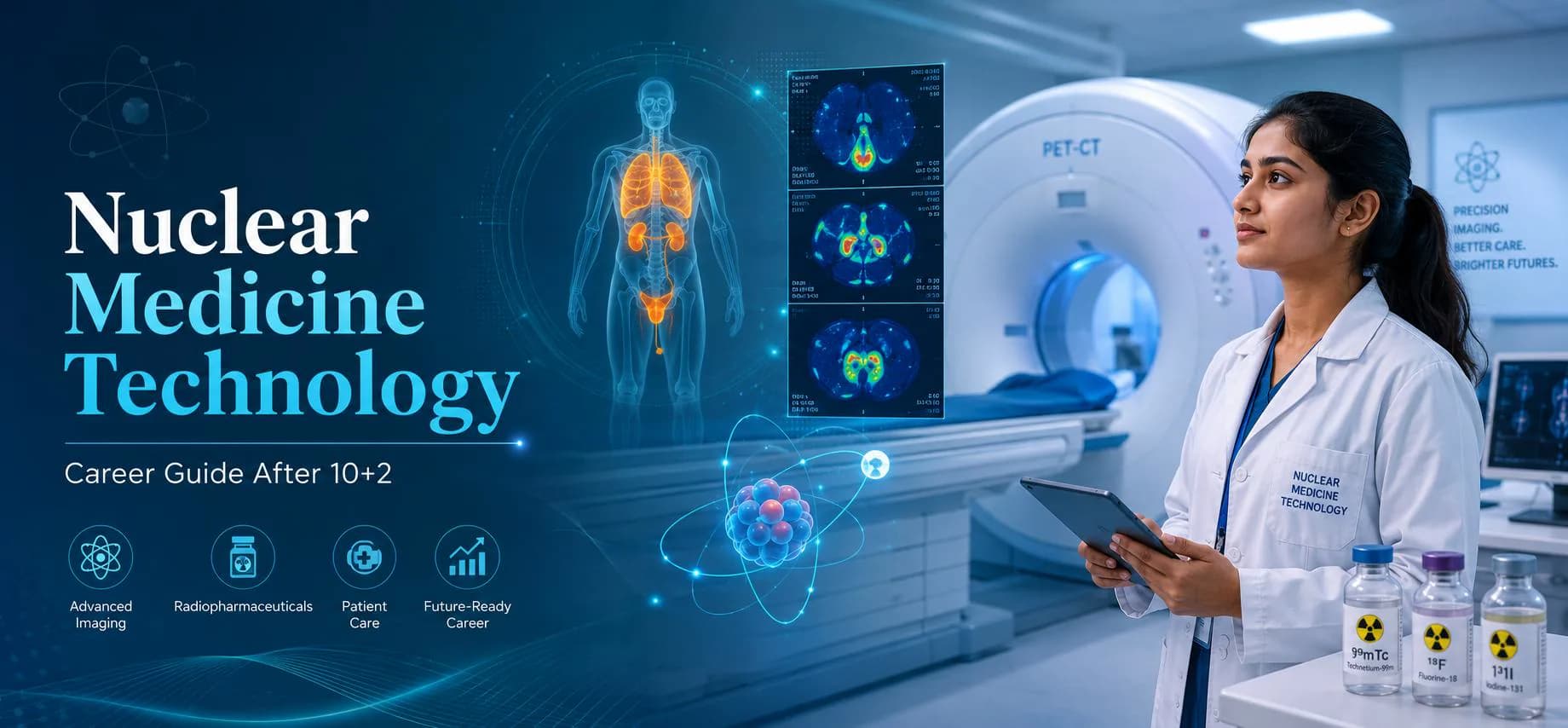
Nuclear medicine technologists blend physics, biology, and patient care to power modern diagnostic imaging.
Just finished (or finishing) your 10+2 with science and wondering what comes next beyond the usual MBBS and engineering routes? Nuclear medicine technology is a lesser-known but genuinely exciting option worth putting on your list. It sits at the meeting point of physics, biology, and patient care: technologists use tiny amounts of radioactive tracers and advanced scanners to help doctors see how organs actually function, and to help deliver targeted treatments for cancer and thyroid disease. You don't need an MBBS to build a rewarding career here — and because the field is growing fast while trained people are scarce, job prospects are strong.
What Does a Nuclear Medicine Technologist Do?
Technologists are the hands-on backbone of every nuclear medicine department. They prepare radiopharmaceuticals (the tracer substances patients receive), operate PET-CT and SPECT scanners, position and reassure patients during scans, and follow strict radiation-safety protocols to keep everyone protected. It's a role that combines technical skill, careful precision, and real human contact with patients every day.
Your Routes In
The usual entry point straight after 10+2 is a BSc in Nuclear Medicine Technology, typically a three-to-four-year undergraduate course. You'll generally need to have completed 10+2 with physics, chemistry, and biology. Many programmes are run by universities and hospital-based institutes and include hands-on training on live PET and SPECT equipment.
If you'd prefer a shorter path, a nuclear medicine course such as a Diploma in Nuclear Medicine Technology (DNMT) is another way to enter the field. Later on, you can advance your career and open up senior and specialised roles with an MSc in Nuclear Medicine Technology.
Job Prospects and Earnings
Demand is steady and growing as the number of scans performed across India keeps rising. Freshers generally start around ₹2.5–5 lakh per year. With one to three years of experience, technologists average roughly ₹7 lakh, and experienced professionals with eight-plus years can reach around ₹11 lakh. Those who build specialised skills in PET-CT or SPECT-CT imaging tend to command higher pay.
Typical workplaces include hospital nuclear medicine and radiology departments, diagnostic imaging chains, radiopharmacy units, and research laboratories. Over time, roles can progress from nuclear medicine technologist to lab supervisor, research assistant, and even teaching positions.
Why Consider It Now
India has relatively few nuclear medicine technologists compared with the number of scanners being installed, and cancer care is shifting toward advanced imaging and theranostics. That means strong job security, room to specialise, and clear paths to grow — all without the years-long, ultra-competitive route that MBBS demands.
Some Institutes Offering These Courses
Several reputed government and private institutions offer BSc (and related diploma/MSc) programmes in Nuclear Medicine Technology. Well-known names include:
- AIIMS, New Delhi — BSc Nuclear Medicine Technology
- AIIMS, Rishikesh — BSc Nuclear Medicine Technology
- Christian Medical College (CMC), Vellore — BSc Nuclear Medicine Technology
- JIPMER, Puducherry — BSc Nuclear Medicine Technology
- SGPGIMS, Lucknow — Nuclear Medicine Technology programme
- Manipal College of Health Professions (MAHE), Manipal — BSc NMT (4-year integrated: 3 years coursework + 1 year internship)
- Sri Ramachandra Institute, Chennai — BSc Nuclear Medicine Technology
- Kovai Medical Center and Hospital, Coimbatore — BSc Nuclear Medicine Technology
- Datta Meghe Institute of Higher Education and Research, Wardha — BSc Nuclear Medicine Technology
Private colleges and organisations
Continue Your Journey
Not sure where to go next?
Whether you're searching for your next healthcare opportunity or hiring qualified professionals, Nextenti helps you connect with the right people through AI-powered matching.
👩⚕️ Looking for Jobs?
Browse verified healthcare opportunities across hospitals, clinics and healthcare organizations.
Browse Jobs →🏥 Hiring Talent?
Post jobs and receive AI-matched healthcare professionals faster.
Private universities and hospital-based institutes are among the biggest providers of the BSc Nuclear Medicine Technology course, and fees vary widely (roughly ₹20,000 to ₹5 lakh+ per year depending on the institution):
- Manipal College of Health Professions, MAHE, Manipal — 4-year integrated BSc NMT (total fees around ₹8.9 lakh)
- Sri Ramachandra Institute of Higher Education and Research, Chennai — BSc NMT
- Datta Meghe Institute of Higher Education and Research, Wardha — BSc NMT (fees around ₹60,000)
- Kovai Medical Center and Hospital, Coimbatore — BSc NMT
- Amrita Vishwa Vidyapeetham, Kochi — allied health sciences including nuclear medicine technology
Larger private hospital groups such as Apollo, Fortis, Medanta, and HCG run busy nuclear medicine departments too, which is where many technologists eventually find nuclear medicine technologist jobs and hands-on training.
There are roughly 15+ institutions across India offering this course. Because eligibility, fees, and AERB recognition can change, always confirm current details and approval status directly with the college before applying.
International Opportunities
A nuclear medicine technology qualification can travel well beyond India. Because this is a specialised field with chronic shortages, hospitals in many countries actively recruit — and sponsor — trained technologists.
In the United States, technologists are in high demand, and hospitals frequently sponsor work visas (commonly the H-1B) because of the shortage. The key requirement is professional certification through the NMTCB (Nuclear Medicine Technology Certification Board) or ARRT (American Registry of Radiologic Technologists); you may need to bridge your Indian qualification to meet their education standards.
In the United Kingdom, you'll typically register with the relevant professional body and apply through the NHS jobs portal, with more vacancies in larger cities like London, Manchester, and Birmingham.
The Gulf/Middle East (UAE, Saudi Arabia, Qatar, Oman) is a popular choice thanks to fast-growing hospitals, tax-free salaries, and licensing through bodies such as DHA, DOH/HAAD, MOH, or SCFHS. Australia, Canada, and Singapore also hire nuclear medicine technologists, each with their own registration and skills-assessment process.
Building specialised PET-CT and SPECT-CT skills, and gaining a few years of solid experience in India first, makes moving abroad much easier later.
The Bottom Line
If you enjoy science, technology, and working with people, and you want a healthcare career that's in rising demand, start with a BSc in Nuclear Medicine programme after your 10+2. Level up later with an MSc or a diploma, pick up PET-CT and SPECT skills, and you'll be entering a small, specialised field that's one of the best positions to be in early in a career.
Note: Course fees, eligibility, seat numbers, and salary figures vary by institution, city, and experience, and change over time. Always verify current details directly with the specific colleges and universities before making decisions.
Nextenti is an AI-powered healthcare hiring platform, built exclusively for the Healthcare industry. Visit nextenti.ai for more information.

About the Author
Dr. Meera Iyer
Clinical Career Coach
Dr. Meera Iyer coaches doctors, nurses, and allied health professionals through hospital placements and specialty transitions across India's healthcare ecosystem.
Featured Jobs
Explore latest openings by profession or location
Jobs by Profession
Browse roles by specialty
Jobs by Location
Explore openings by city
Featured Jobs
Explore latest openings by profession or location
Jobs by Profession
Browse roles by specialty
Jobs by Location
Explore openings by city
Keep Reading
You Might Also Like
 Career Guides
D Pharma Career Guide: Salary, Scope & Pharmacist Jobs in India
Learn about D Pharma eligibility, fees, salary, scope, career options and pharmacist jobs in India. Explore opportunities and career growth after D Pharma.

Dr. Meera Iyer
06 Oct 2026
 Lab Technician
Lab Technician Course Guide: MLT, DMLT, Fees, Salary & Jobs in India (2026)
Explore lab technician courses after 12th, DMLT, BSc MLT, eligibility, fees, salary, career scope and lab technician jobs in India.
Arvind Shetty
06 Oct 2026
 Lab Technician
DMLT Salary in India 2026: Per Month Pay, Growth & Lab Jobs
Learn about DMLT salary in India 2026, monthly pay, starting salary, government salary, career scope and the latest DMLT jobs across India.
Priyanka Das
06 Oct 2026