Why Every Healthcare Professional Plays a Critical Role

Dr. Meera Iyer
17 Aug 2026 · 12 min read
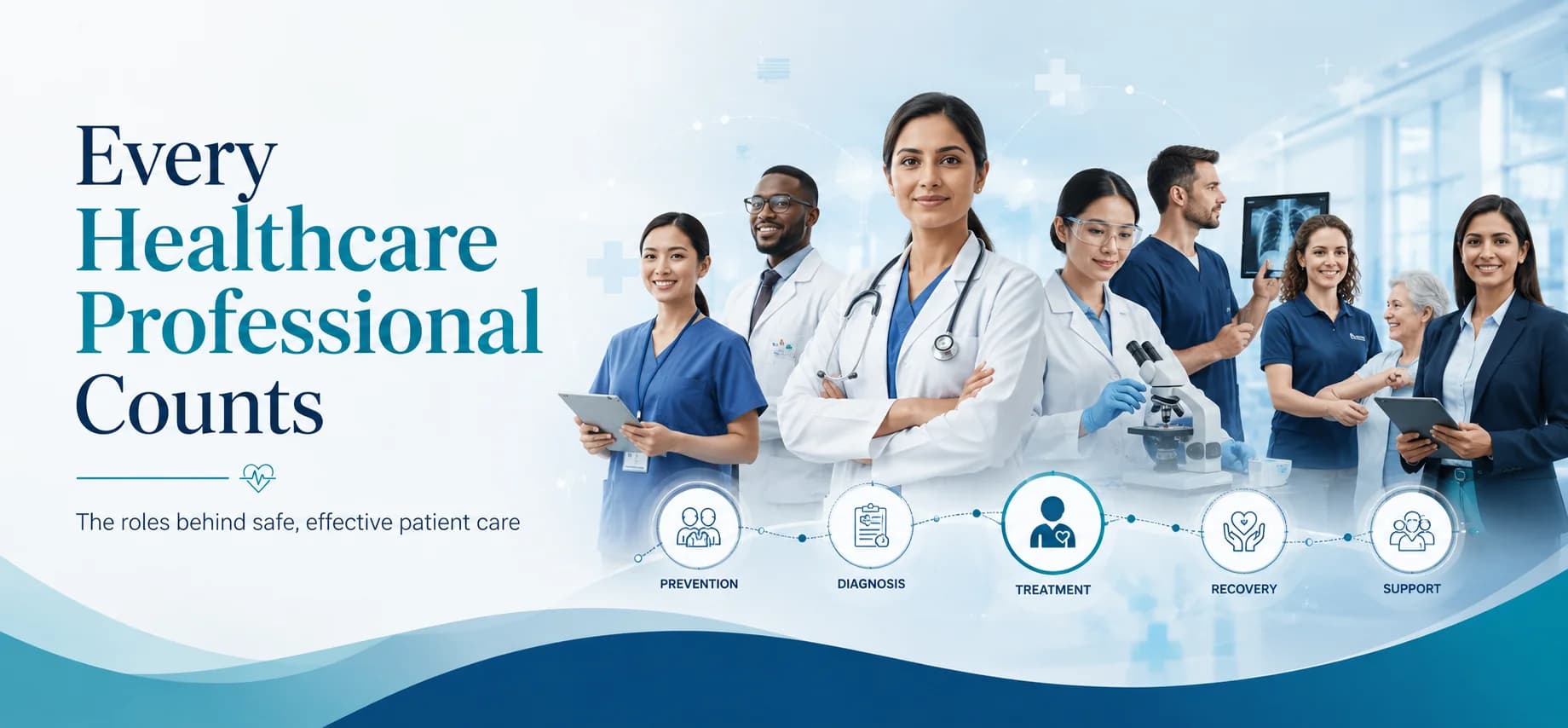
Every healthcare role connects to another — the patient journey depends on the whole team, not one profession.
Healthcare is often associated with doctors, nurses and hospitals. But a patient's journey rarely depends on one person. Behind every diagnosis, treatment, procedure, discharge and follow-up is a team of professionals whose work contributes to the quality, safety and continuity of care.
This is why understanding the importance of healthcare workers goes beyond recognising a few visible clinical roles. Healthcare works as a connected system, and every professional has a responsibility within that system.
From doctors and nurses to pharmacists, laboratory professionals, physiotherapists, medical coders, radiographers, healthcare administrators and support teams, each person contributes to a larger objective: helping patients receive timely, safe and effective care.
The importance of healthcare workers in modern healthcare
Healthcare organisations are becoming increasingly complex. Patient expectations are changing, technology is evolving, specialised treatments are expanding, and hospitals must balance clinical quality with operational efficiency.
In this environment, the role of healthcare workers cannot be viewed in isolation.
A doctor may identify a clinical problem, but accurate diagnosis may depend on a laboratory professional or radiographer. A treatment plan may depend on a pharmacist's expertise. Recovery may require a physiotherapist. Documentation and coding professionals help ensure that clinical information is accurately recorded and processed. Healthcare administrators coordinate people, resources and processes so that services function effectively.
Every role connects with another.
When one part of the healthcare workforce is unavailable, delayed or poorly coordinated, the impact can extend across the patient journey.
Healthcare is a team effort
A healthcare organisation is not simply a collection of individual professionals. It is a team working toward a common purpose.
Consider a patient admitted for a medical condition. The journey may involve:
- A doctor assessing the patient's condition and developing a treatment plan
- Nurses monitoring the patient and providing continuous care
- Laboratory professionals conducting and processing diagnostic tests
- Radiographers supporting imaging and diagnostic procedures
- Pharmacists reviewing medications and supporting safe medication use
- Physiotherapists helping patients regain mobility and function
- Dietitians supporting nutritional requirements where appropriate
- Medical coders and health information professionals maintaining accurate clinical information
- Hospital administrators coordinating resources, departments and operations
- Technicians and other support professionals ensuring that essential services function properly
This demonstrates the importance of healthcare team roles. No single professional can provide every service required by a modern healthcare system.
Why allied health professionals are essential
One of the most important lessons in healthcare workforce management is that patient care extends far beyond doctors and nurses.
The importance of allied health professionals has grown as healthcare becomes more specialised and multidisciplinary.
Allied health professionals contribute expertise that supports diagnosis, treatment, rehabilitation, prevention and long-term recovery.
Depending on the healthcare setting, this can include:
- Medical laboratory professionals
- Physiotherapists
- Occupational therapists
- Radiographers
- Respiratory therapists
- Dietitians and nutrition professionals
- Medical technologists
- Audiologists and speech-language professionals
- Optometrists
- Other specialised healthcare professionals
Their contribution may not always be visible to the patient, but it can be critical to achieving a successful outcome.
A laboratory professional, for example, may not interact extensively with a patient, but accurate laboratory results can influence a physician's diagnosis and treatment decisions.
Similarly, a physiotherapist may become particularly important after the immediate medical problem has been treated, helping the patient move toward functional recovery.
Healthcare quality therefore depends not only on who treats the patient directly, but also on the professionals who make that treatment possible.
Every role contributes to the patient journey
A useful way to understand the importance of healthcare workers is to look at the patient journey as a chain.
A patient may move through registration, consultation, investigation, diagnosis, treatment, medication, monitoring, rehabilitation and follow-up.
Each stage requires different capabilities.
A delay at one point can affect the next.
For example, if diagnostic information is delayed, treatment may also be delayed. If medication information is incomplete, the treatment process can become more complicated. If discharge planning is not coordinated properly, the patient's transition from hospital to home may be affected.
This is why healthcare organisations need to look at the workforce as an interconnected system rather than evaluating departments independently.
The changing role of healthcare professionals
Healthcare professionals today are expected to do more than perform technical tasks.
Modern healthcare increasingly requires:
- Clinical competence
- Communication
- Teamwork
- Adaptability
- Problem-solving
- Digital literacy
- Data awareness
- Continuous learning
- Patient-centred thinking
- Ethical decision-making
Technology is changing how healthcare is delivered, but technology does not eliminate the need for people.
Artificial intelligence, automation, electronic health records and digital health platforms can improve processes and support decision-making. However, healthcare still depends on professionals who understand patients, interpret information, communicate effectively and make responsible decisions.
The future of healthcare is therefore not simply about technology replacing workers. It is about people and technology working together more effectively.
Why healthcare staff matter beyond clinical care
The phrase why healthcare staff matter should include everyone who contributes to the functioning of a healthcare organisation.
Healthcare staff influence more than clinical outcomes.
They also affect:
- Patient experience
- Operational efficiency
- Waiting times
- Resource utilisation
- Communication
- Documentation
- Safety
- Service continuity
- Employee experience
- Organisational performance
A hospital can invest in advanced infrastructure and technology, but those resources deliver value only when the right people are available and equipped to use them effectively.
This makes workforce planning an important part of healthcare management.
Healthcare workforce importance: having the right people in the right roles
The healthcare workforce importance becomes particularly clear when organisations face shortages, changing patient demand or new service requirements.
Healthcare organisations need to ask practical questions:
- Do we have enough professionals for current patient demand?
- Do we have the right skills across departments?
- Where are the workforce gaps?
- Which roles are becoming more important?
- Are professionals being deployed effectively?
- Are employees receiving opportunities to learn and develop?
- How can organisations improve retention?
Workforce planning should not be limited to filling vacancies.
It should focus on understanding the skills required by the organisation and ensuring that professionals can contribute effectively.
This is where data and workforce analytics can support healthcare leaders. Data can help organisations understand workforce patterns, identify gaps, anticipate demand and make better-informed decisions.
But data should support human judgement, not replace it.
Recognising different types of healthcare professionals
Continue Your Journey
Not sure where to go next?
Whether you're searching for your next healthcare opportunity or hiring qualified professionals, Nextenti helps you connect with the right people through AI-powered matching.
👩⚕️ Looking for Jobs?
Browse verified healthcare opportunities across hospitals, clinics and healthcare organizations.
Browse Jobs →🏥 Hiring Talent?
Post jobs and receive AI-matched healthcare professionals faster.
Understanding the types of healthcare professionals helps us appreciate how broad the healthcare ecosystem really is.
They can broadly include:
Doctors and physicians
Doctors diagnose conditions, develop treatment plans, perform procedures and make clinical decisions across numerous specialities.
Nurses
Nurses provide continuous patient care, monitor patients, administer treatments, educate patients and coordinate with other healthcare professionals.
Pharmacists
Pharmacists contribute to medication management, safe medication use, patient education and pharmaceutical care.
Allied health professionals
These professionals support diagnosis, rehabilitation, treatment and patient recovery through specialised expertise.
Laboratory professionals
Laboratory teams generate and analyse diagnostic information that can help clinicians understand a patient's condition.
Radiology and imaging professionals
Radiology and imaging teams support diagnosis and treatment through imaging services and specialised technical expertise.
Healthcare administrators
Administrators help coordinate people, processes, resources, finances and services so that healthcare organisations can function effectively.
Health information and medical coding professionals
These professionals contribute to accurate documentation, coding, information management and healthcare data processes.
Healthcare technology professionals
Technology teams support digital systems, healthcare applications, data infrastructure, cybersecurity and other technology-enabled services.
Support and operational teams
Many essential services depend on professionals working in areas such as facilities, housekeeping, biomedical support, patient coordination, logistics and other operational functions.
Each category contributes differently, but their work is connected.
Building a stronger healthcare workforce
If every worker contributes to healthcare delivery, organisations need to create an environment where professionals can perform at their best.
That means looking beyond recruitment alone.
A stronger healthcare workforce requires:
- Right talent: Organisations need professionals with the skills required for their services.
- Continuous learning: Healthcare changes continuously, so professionals need opportunities to update their knowledge and capabilities.
- Effective deployment: Having skilled professionals is not enough; their skills need to be aligned with organisational and patient needs.
- Recognition: Professionals are more likely to contribute effectively when their work and expertise are recognised.
- Career development: Clear opportunities for growth can support engagement and retention.
- Collaboration: Different professional groups need opportunities to communicate and work together.
- Technology enablement: Digital tools should make work more efficient while allowing professionals to focus on higher-value responsibilities.
The future of healthcare depends on every worker
Healthcare is moving toward a more connected, multidisciplinary and technology-enabled model.
As this happens, the boundaries between different healthcare roles may evolve, but the need for collaboration will become even more important.
A successful healthcare organisation will not be defined only by the number of doctors it employs or the technology it owns. Its strength will also depend on whether it can build, develop and retain a capable workforce across every critical function.
This brings us back to a simple principle:
“Every healthcare professional counts.”
The doctor who makes the diagnosis matters. The nurse who monitors the patient matters. The pharmacist who supports safe medication use matters. The laboratory professional who provides accurate results matters. The physiotherapist who supports recovery matters. The administrator who keeps the system functioning matters. The technology professional who enables digital healthcare matters.
Their responsibilities may be different, but their purpose is connected.
Conclusion
The importance of healthcare workers lies in the collective value they create. Healthcare is not delivered by one profession; it is delivered through a network of people with different skills, responsibilities and areas of expertise.
Recognising the role of healthcare workers, including allied health professionals and non-clinical teams, is essential for building stronger healthcare organisations.
For healthcare employers, this means thinking strategically about talent, skills, workforce planning, career development and retention. For healthcare professionals, it means recognising that their contribution has value within a much larger system.
When every professional has the right skills, support and opportunity to contribute, the entire healthcare system becomes stronger.
Every worker counts because every role contributes to better healthcare.
Ready to put this into action? Explore our Career Guide, browse allied health jobs, or find nursing jobs on Nextenti.
Frequently Asked Questions
Why is every healthcare professional important?
Every healthcare professional contributes a specific skill or service to the patient journey. Doctors, nurses, pharmacists, allied health professionals, laboratory teams, administrators and other staff work together to support diagnosis, treatment, recovery, safety and healthcare operations.
What roles make up a healthcare team?
A healthcare team can include doctors, nurses, pharmacists, allied health professionals, laboratory professionals, imaging specialists, healthcare administrators, medical coders, health information professionals, technology teams and operational support staff.
How do allied health workers support patient care?
Allied health workers provide specialised services that support diagnosis, treatment, rehabilitation, prevention and recovery. Their expertise complements the work of doctors and nurses and helps address different aspects of patient needs.
Why is the healthcare workforce critical?
The healthcare workforce is critical because healthcare services depend on skilled people to deliver clinical care, operate essential systems, manage resources, use technology and support patients throughout their healthcare journey.
What are the different types of healthcare professionals?
Healthcare professionals include doctors, nurses, pharmacists, laboratory professionals, physiotherapists, occupational therapists, radiographers, dietitians, medical technologists, healthcare administrators, medical coders, health information professionals, healthcare technology specialists and many other specialised roles.

About the Author
Dr. Meera Iyer
Clinical Career Coach
Dr. Meera Iyer coaches doctors, nurses, and allied health professionals through hospital placements and specialty transitions across India's healthcare ecosystem.
Featured Jobs
Explore latest openings by profession or location
Jobs by Profession
Browse roles by specialty
Jobs by Location
Explore openings by city
Featured Jobs
Explore latest openings by profession or location
Jobs by Profession
Browse roles by specialty
Jobs by Location
Explore openings by city
Keep Reading
You Might Also Like
 Career Guides
D Pharma Career Guide: Salary, Scope & Pharmacist Jobs in India
Learn about D Pharma eligibility, fees, salary, scope, career options and pharmacist jobs in India. Explore opportunities and career growth after D Pharma.

Dr. Meera Iyer
06 Oct 2026
 Lab Technician
Lab Technician Course Guide: MLT, DMLT, Fees, Salary & Jobs in India (2026)
Explore lab technician courses after 12th, DMLT, BSc MLT, eligibility, fees, salary, career scope and lab technician jobs in India.
Arvind Shetty
06 Oct 2026
 Lab Technician
DMLT Salary in India 2026: Per Month Pay, Growth & Lab Jobs
Learn about DMLT salary in India 2026, monthly pay, starting salary, government salary, career scope and the latest DMLT jobs across India.
Priyanka Das
06 Oct 2026