Healthcare Interview Questions and Answers: A Complete Guide

Dr. Meera Iyer
18 Aug 2026 · 13 min read
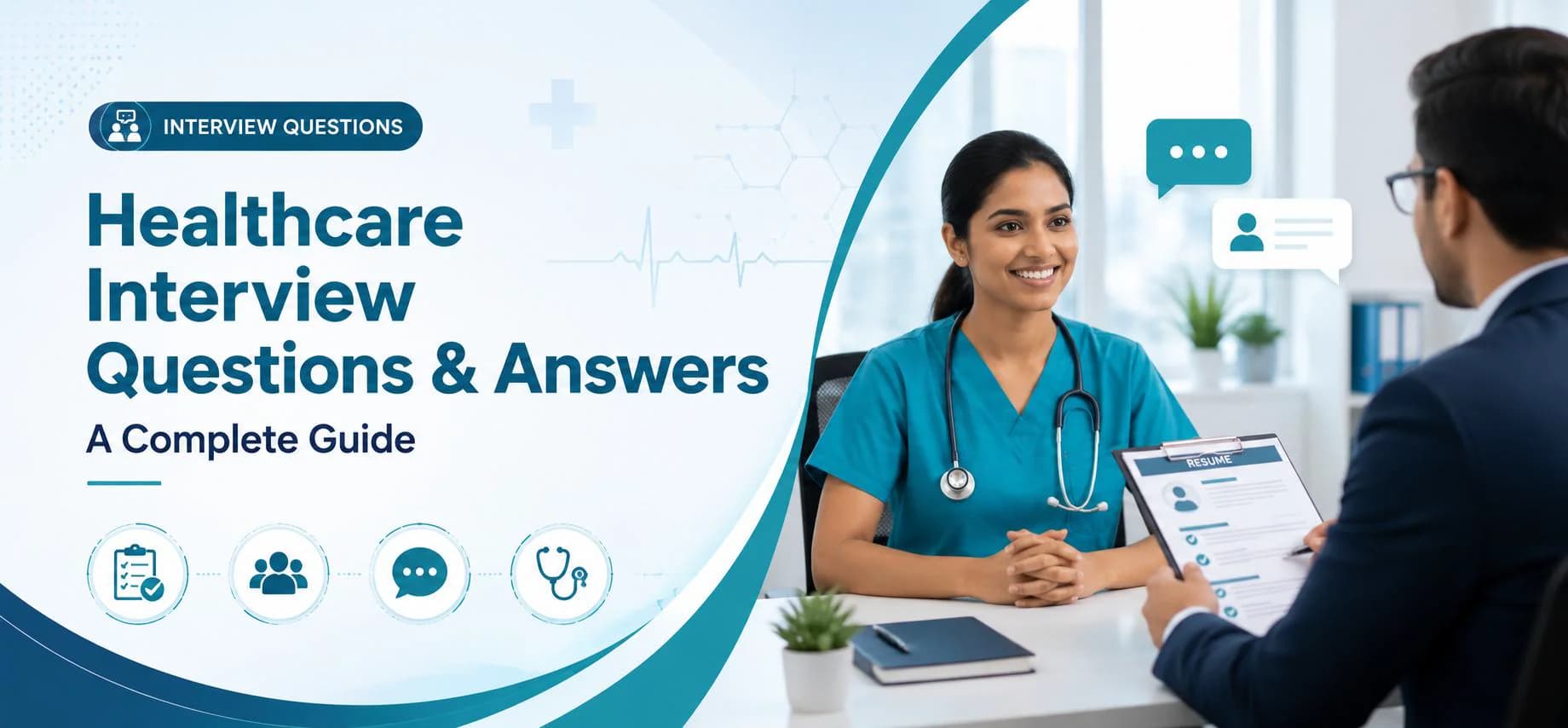
Preparing for a healthcare interview is about more than memorising answers — it's about communicating who you are as a professional.
A healthcare interview is rarely just a conversation about qualifications.
Whether you are a doctor, nurse, pharmacist, medical coder, laboratory professional, hospital administrator, or another healthcare professional, an interview is an opportunity for an employer to understand more than what is written on your resume. It is a chance to understand how you think, communicate, respond to challenges, work with people, and handle responsibility.
This is why preparing for healthcare interview questions requires more than memorising standard answers.
A strong candidate prepares to have a meaningful conversation.
Why Healthcare Interviews Are Different
Healthcare is a people-centric industry. Technical knowledge is important, but healthcare professionals also work in situations that require communication, empathy, teamwork, accountability and sound judgement.
A hospital may therefore evaluate a candidate on several dimensions:
- Professional qualifications and experience
- Clinical or technical knowledge
- Communication skills
- Patient-centred thinking
- Teamwork and collaboration
- Problem-solving ability
- Adaptability
- Ethical judgement
- Ability to work under pressure
- Willingness to learn
For doctors and nurses, clinical competence may naturally receive significant attention. For administrative, HR, operations, laboratory, pharmacy and healthcare technology roles, employers may place greater emphasis on operational knowledge, communication, analytical thinking and organisational skills.
The important point is that an interview is not simply a test of what you know. It is also an assessment of how you apply what you know.
A Lesson From an Unexpected Interview Question
One of the most useful interview lessons comes from an experience shared by Dr. Devanand Kolothodi.
During an early-career interview, he was asked a seemingly simple question: “What's your ambition?”
He had not prepared for the question. Instead of giving a rehearsed response, he answered honestly about his earlier ambitions and the different directions his career had taken.
The conversation eventually revealed that the organisation had already selected another candidate. Yet the interviewer appreciated his honesty and offered him advice for future interviews.
The experience carried an important lesson: not every interview is about getting the job. Sometimes an interview gives you clarity, feedback or direction for the next opportunity.
This is particularly relevant for healthcare professionals at the beginning of their careers. A rejected interview should not automatically be interpreted as a judgement on your professional worth.
Sometimes, you simply need more preparation. Sometimes another candidate is a closer match. And sometimes the opportunity itself is not the right fit.
The objective is to learn from every interview.
Common Healthcare Interview Questions and Answers
1. Tell me about yourself.
This is one of the most common questions in healthcare interviews.
Do not turn your answer into a complete biography. Instead, create a short professional introduction covering:
- Your qualification
- Your relevant experience
- Your key skills
- Your current professional focus
- Why you are interested in the role
Example
“I am a registered nurse with three years of experience in a multispecialty hospital, primarily working in critical care. My experience has helped me develop strong clinical, communication and patient-care skills. I have also worked closely with multidisciplinary teams and handled high-pressure situations. I am now looking for an opportunity where I can take on greater responsibility while continuing to develop professionally.”
The answer should sound natural rather than memorised.
2. Why do you want to work in this hospital?
This question tests whether you have researched the organisation.
Before the interview, understand:
- The hospital's specialties
- Its reputation
- Its values
- The role you are applying for
- Opportunities for professional development
- The type of patients or services it handles
Avoid answers such as:
“Because I need a job.”
Instead, connect your career goals with the organisation.
Example
“I am interested in this hospital because of its reputation in tertiary care and its focus on quality patient services. My experience aligns well with the requirements of this position, and I believe the environment would also give me an opportunity to learn and contribute.”
3. What are your strengths?
Choose strengths that are relevant to the position.
For a nurse, these might include:
- Patient communication
- Clinical observation
- Teamwork
- Time management
- Calmness under pressure
For a doctor:
- Clinical decision-making
- Patient communication
- Multidisciplinary collaboration
- Continuous learning
For a hospital administrator:
- Operations management
- Team leadership
- Problem-solving
- Process improvement
Whenever possible, support your strength with an example.
Instead of saying:
“I am a good team player.”
Say:
“I work well in multidisciplinary teams. In my previous role, I regularly coordinated with doctors, nurses and support teams to ensure timely patient care.”
4. What is your biggest weakness?
This can become a difficult question if you try to present yourself as perfect.
Avoid answers such as:
“I don't have any weaknesses.”
Instead, identify a genuine professional development area and explain what you are doing about it.
Example
“Earlier in my career, I sometimes spent too much time trying to perfect tasks before moving forward. I have been working on prioritisation and time management so that I can maintain quality while also meeting deadlines.”
The important part is not the weakness alone. It is your awareness and willingness to improve.
Nursing Interview Questions
Nursing interviews often explore both clinical competence and patient-centred behaviour.
Common nursing interview questions may include:
- Why did you choose nursing as a career?
- How do you handle a difficult patient?
- How do you prioritise multiple patients?
- How do you handle an emergency?
- How do you communicate with a patient's family?
- How do you manage conflict with a colleague?
- What would you do if you noticed a medication error?
- How do you maintain patient confidentiality?
- How do you deal with stress and long shifts?
- What are your key clinical strengths?
When answering scenario-based questions, structure your response logically.
Explain:
“Situation → Action → Reasoning → Outcome”
This helps the interviewer understand not only what you did, but why you did it.
Doctor Interview Questions
Doctors can expect a combination of clinical, behavioural and professional questions.
Common doctor interview questions include:
- Tell us about your clinical experience.
- Why are you interested in this hospital?
- What are your areas of clinical expertise?
- How do you communicate difficult information to patients?
- How do you handle disagreements with colleagues?
- How do you manage a difficult case?
- How do you keep yourself updated with medical developments?
- How do you handle pressure?
- How do you approach patient safety?
- Where do you see your career progressing?
For experienced doctors, the conversation may also move beyond clinical skills into leadership, quality improvement, teamwork, patient experience and operational understanding.
A good answer demonstrates professional maturity rather than simply listing achievements.
Hospital Interview Questions for Non-Clinical Roles
Healthcare organisations employ far more than doctors and nurses.
Hospital interviews can also involve professionals in:
- Administration
- Human resources
- Finance
- Marketing
- Operations
- Medical coding
- Pharmacy
- Laboratory services
- Healthcare IT
- Quality
- Facility management
Questions may include:
- How would you handle a difficult stakeholder?
- How do you prioritise competing tasks?
- Tell us about a problem you solved.
- How do you manage a team?
- How do you respond to workplace conflict?
- How do you measure performance?
- How would you improve an inefficient process?
- How do you work under pressure?
- Why do you want to build your career in healthcare?
For these roles, demonstrate that you understand the healthcare environment—not just your functional area.
How to Handle Tricky Healthcare Interview Questions
Some interview questions are difficult because there is no single “correct” answer.
Examples include:
- “Why should we hire you?” — Connect your skills with the employer's requirement.
- “Why did you leave your previous organisation?” — Remain professional. Do not criticise your former employer or colleagues.
- “Why were you unemployed for a period?” — Be honest and explain how you used the time constructively.
- “What salary do you expect?” — Research the role and market before the interview. Consider your qualifications, experience, location, responsibilities and industry standards.
- “Where do you see yourself in five years?” — Show ambition, but keep it realistic.
- “What would you do if you disagreed with a senior?” — Demonstrate respect, communication and professional judgement.
Continue Your Journey
Not sure where to go next?
Whether you're searching for your next healthcare opportunity or hiring qualified professionals, Nextenti helps you connect with the right people through AI-powered matching.
👩⚕️ Looking for Jobs?
Browse verified healthcare opportunities across hospitals, clinics and healthcare organizations.
Browse Jobs →🏥 Hiring Talent?
Post jobs and receive AI-matched healthcare professionals faster.
The goal is not to provide the answer you think the interviewer wants to hear.
The goal is to provide an answer that is honest, professional and relevant.
Healthcare Interview Tips That Can Make a Difference
1. Research the organisation
Do not walk into an interview knowing only the hospital's name.
Understand its services, specialties, locations, values and the position you are applying for.
2. Understand the job description
The job description often tells you what the interviewer is likely to explore.
Identify the important skills and prepare examples from your experience.
3. Prepare—but don't memorise
Preparation is essential.
However, memorising complete answers can make you sound unnatural.
Prepare key points instead.
4. Use real examples
When answering behavioural questions, examples are more powerful than generic statements.
Instead of:
“I can work under pressure.”
Explain a situation where you actually worked under pressure.
5. Be honest
Healthcare is built on trust.
Your interview should reflect the same principle.
If you do not know an answer, it is better to acknowledge it professionally than to invent one.
You can say:
“I am not completely sure about that at the moment, but I would approach it by…”
Honesty combined with a willingness to learn is often more valuable than false confidence.
6. Prepare your own questions
An interview is not only an opportunity for the hospital to evaluate you.
It is also an opportunity for you to evaluate the organisation.
You can ask:
- What does success look like in this role?
- What are the key responsibilities during the first few months?
- What professional development opportunities are available?
- How is performance evaluated?
- What does the team structure look like?
Good questions demonstrate genuine interest.
Medical Interview Preparation: What to Do Before the Interview
A simple preparation routine can make a significant difference.
24–48 hours before
Review:
- Your resume
- Job description
- Qualifications
- Certifications
- Relevant experience
- Organisation information
- Common interview questions
Prepare five to six professional examples that demonstrate:
- Leadership
- Teamwork
- Problem-solving
- Conflict management
- Patient interaction
- Handling pressure
- Learning from failure
On the day
Carry the necessary documents and arrive early.
Dress professionally.
Keep your phone away during the interview.
Listen carefully to each question before answering.
Most importantly, do not rush.
A short pause to think is perfectly acceptable.
What If You Don't Get the Job?
This is where the interview journey becomes a learning experience.
A rejection can feel personal, particularly when you believe you were qualified for the position.
But hiring decisions depend on many factors.
Another candidate may have had more relevant experience. The organisation may have changed its requirements. Internal candidates may have been considered. Or the position may simply have been a better fit for someone else.
The right response is not to stop applying.
Ask yourself:
- What questions did I struggle with?
- Did I communicate my experience clearly?
- Was my resume aligned with the role?
- Did I research the organisation?
- Could I improve my technical knowledge?
- Did I demonstrate confidence without overconfidence?
- What feedback can I use next time?
One interview can teach you something that no preparation guide can.
That is why every interview should be treated as both an opportunity and a learning experience.
The Best Interview Preparation Is Self-Preparation
Interview preparation is often reduced to a list of questions and model answers.
But successful healthcare professionals need something deeper: clarity about who they are, what they can contribute and where they want to go.
When you understand your own experience, strengths, limitations and ambitions, unexpected questions become easier to handle.
You do not need to have a perfect answer to every question.
You need to be able to think, communicate and respond honestly.
The healthcare industry needs professionals who can combine knowledge with judgement, technical competence with empathy, and ambition with continuous learning.
Your interview is the first opportunity to demonstrate those qualities.
And sometimes, as Dr. Devanand Kolothodi's own interview experience illustrates, an interview that does not result in an immediate job can still become an important step in your career journey.
Conclusion
Preparing for healthcare interview questions and answers is not about memorising a script.
It is about understanding the role, knowing your own strengths, preparing relevant examples and communicating with honesty and confidence.
Whether you are preparing for nursing interview questions, doctor interview questions, hospital interview questions, or an interview for another healthcare position, remember that the interviewer is looking for more than qualifications.
They are looking for someone who can contribute to the organisation, work effectively with people, learn continuously and take responsibility.
Ready to prepare fully? Explore our Resume Tips and browse healthcare job openings on Nextenti.
Frequently Asked Questions
What are common healthcare interview questions?
Common healthcare interview questions include “Tell me about yourself,” “Why do you want to work here?”, “What are your strengths and weaknesses?”, “How do you handle pressure?”, “How do you manage difficult patients or colleagues?”, and role-specific clinical or technical questions.
How do I answer “Tell me about yourself” in a healthcare interview?
Keep your answer professional and relevant. Briefly explain your qualifications, relevant experience, key skills and why you are interested in the position. Avoid giving a lengthy personal history.
What questions are asked to nurses and doctors?
Nurses may be asked about patient care, emergencies, prioritisation, medication safety, communication and teamwork. Doctors may face questions about clinical experience, decision-making, patient communication, specialisation, teamwork and handling complex situations.
How do I prepare for a hospital interview?
Research the hospital, understand the job description, review your resume, prepare examples from your experience, practise common questions and prepare thoughtful questions for the interviewer.
How do I handle tricky interview questions?
Pause before answering, understand what the interviewer is asking and respond honestly. Use real examples where possible. If you do not know something, acknowledge it professionally and explain how you would find the answer or approach the situation.

About the Author
Dr. Meera Iyer
Clinical Career Coach
Dr. Meera Iyer coaches doctors, nurses, and allied health professionals through hospital placements and specialty transitions across India's healthcare ecosystem.
Featured Jobs
Explore latest openings by profession or location
Jobs by Profession
Browse roles by specialty
Jobs by Location
Explore openings by city
Featured Jobs
Explore latest openings by profession or location
Jobs by Profession
Browse roles by specialty
Jobs by Location
Explore openings by city
Keep Reading
You Might Also Like
 Career Guides
D Pharma Career Guide: Salary, Scope & Pharmacist Jobs in India
Learn about D Pharma eligibility, fees, salary, scope, career options and pharmacist jobs in India. Explore opportunities and career growth after D Pharma.

Dr. Meera Iyer
06 Oct 2026
 Lab Technician
Lab Technician Course Guide: MLT, DMLT, Fees, Salary & Jobs in India (2026)
Explore lab technician courses after 12th, DMLT, BSc MLT, eligibility, fees, salary, career scope and lab technician jobs in India.
Arvind Shetty
06 Oct 2026
 Lab Technician
DMLT Salary in India 2026: Per Month Pay, Growth & Lab Jobs
Learn about DMLT salary in India 2026, monthly pay, starting salary, government salary, career scope and the latest DMLT jobs across India.
Priyanka Das
06 Oct 2026