Pharma Industry Interview Questions & Answers 2026

Rahul Varma
06 Oct 2026 · 9 min read
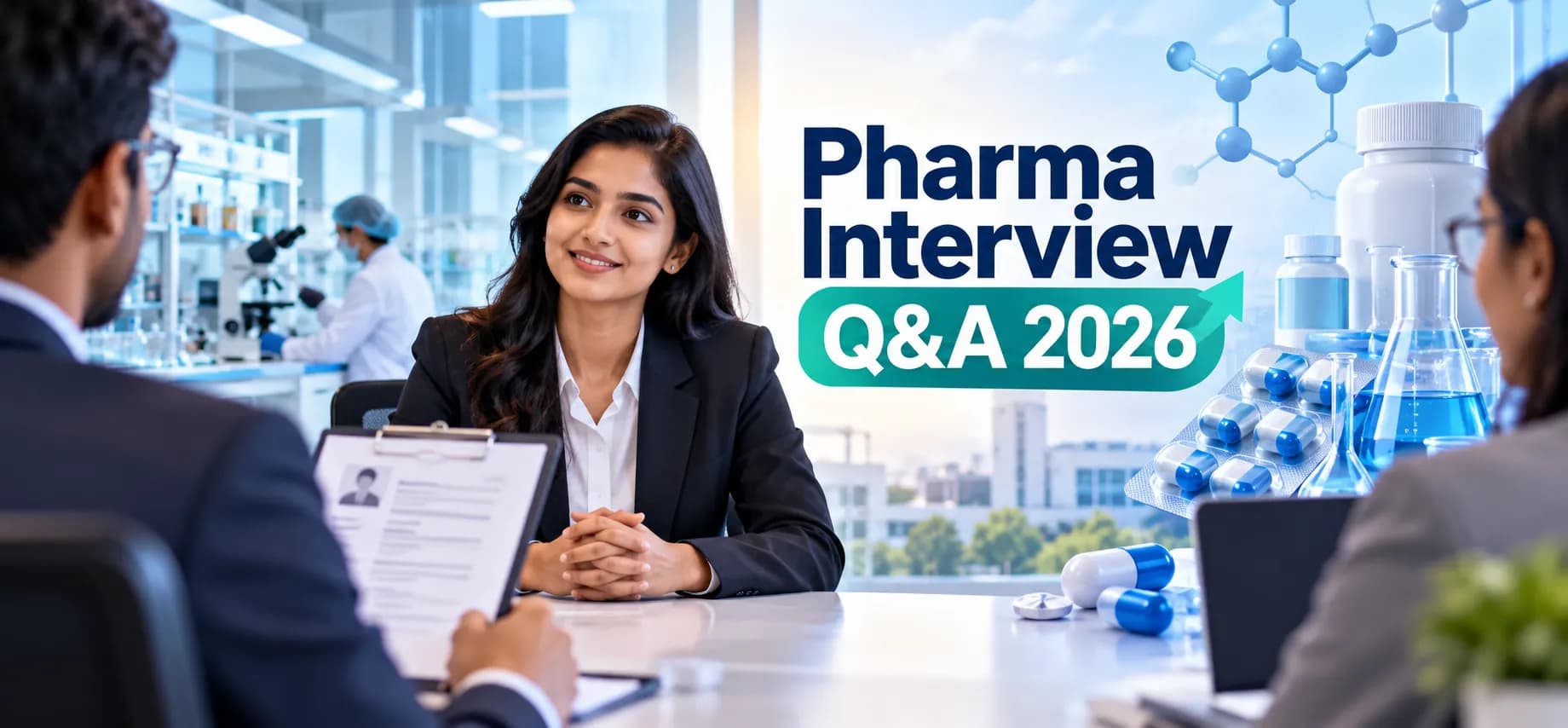
Pharma recruiters assess GMP knowledge, documentation discipline and quality awareness alongside academic fundamentals when hiring for QA, QC and production roles.
The Indian pharmaceutical industry continues to be one of the fastest-growing sectors in healthcare, creating thousands of opportunities for fresh graduates and experienced professionals. Whether you're applying for roles in Quality Assurance (QA), Quality Control (QC), Production, Research & Development (R&D), Regulatory Affairs, Pharmacovigilance, Medical Coding, Sales, or Clinical Research, preparing for pharma interview questions is essential to secure your dream job and explore relevant Healthcare Jobs.
Recruiters today look beyond academic knowledge. They assess technical expertise, problem-solving abilities, communication skills, compliance awareness, and your understanding of pharmaceutical regulations.
Why Pharma Interviews Are Different
Unlike many industries, pharmaceutical interviews focus heavily on:
- Technical knowledge
- GMP and regulatory compliance
- Documentation practices
- Quality standards
- Analytical thinking
- Patient safety awareness
- Communication skills
- Teamwork
Candidates are expected to understand not only their academic subjects but also real-world pharmaceutical practices.
Common Pharma Interview Questions and Answers
1. Tell me about yourself.
Sample Answer
“I completed my Bachelor's in Pharmacy and developed a strong interest in pharmaceutical manufacturing and quality systems. During my internship, I gained exposure to GMP documentation, dispensing procedures, and quality control testing. I'm eager to apply my knowledge in a reputed pharmaceutical organization where I can continuously learn and contribute.”
Tip: Keep your introduction under two minutes.
2. Why do you want to work in the pharmaceutical industry?
Sample Answer
“I want to work in the pharmaceutical industry because it directly contributes to improving patient health. It offers opportunities to combine scientific knowledge with innovation while maintaining high-quality standards and regulatory compliance.”
3. Why should we hire you?
Sample Answer
“My academic background, willingness to learn, attention to detail, and understanding of pharmaceutical processes make me a suitable candidate. I adapt quickly, work well in teams, and always prioritize quality and patient safety.”
4. What do you know about our company?
Before attending any interview:
- Research company products
- Manufacturing facilities
- Therapeutic areas
- Recent achievements
- Regulatory approvals
- Company values
Interviewers expect candidates to know basic information about the organization.
5. What are your strengths?
Examples:
- Attention to detail
- Documentation skills
- Time management
- Analytical thinking
- Communication
- Problem-solving
- Team collaboration
6. What is your biggest weakness?
Choose a genuine but manageable weakness.
Example:
“I initially hesitate before asking questions, but I've learned that clarifying doubts early improves productivity and reduces mistakes.”
Pharma HR Interview Questions
HR interviews evaluate personality, attitude, and workplace behavior.
Why do you want to join our company?
Show that you've researched the organization and align your goals with its mission.
Are you willing to work in shifts?
Most pharmaceutical manufacturing facilities operate 24×7.
Sample Answer:
“Yes. I understand shift work is part of pharmaceutical manufacturing, and I'm comfortable working flexible schedules.”
How do you handle work pressure?
Discuss:
- Prioritization
- Time management
- Staying organized
- Maintaining quality despite deadlines
Where do you see yourself in five years?
Focus on professional growth.
Example:
“I hope to become a skilled pharmaceutical professional with expertise in quality systems while taking on greater responsibilities.”
Can you relocate?
Answer honestly while showing flexibility whenever possible.
Pharma Technical Interview Questions
Technical interviews differ based on department.
What is GMP?
Good Manufacturing Practices (GMP) are guidelines ensuring pharmaceutical products are consistently manufactured and controlled according to quality standards.
Purpose:
- Product quality
- Patient safety
- Documentation
- Process consistency
What is GLP?
Good Laboratory Practices (GLP) ensure laboratory studies are conducted with quality, integrity, and proper documentation.
What is GDP?
Good Documentation Practices (GDP) ensure all pharmaceutical records are:
- Accurate
- Legible
- Complete
- Timely
- Traceable
What is SOP?
A Standard Operating Procedure (SOP) is a written instruction describing how to perform a process consistently and correctly.
What is validation?
Validation is documented evidence proving that a process consistently produces products meeting predetermined specifications.
Types include:
- Process validation
- Cleaning validation
- Equipment validation
- Analytical method validation
Difference between QA and QC
| QA | QC |
|---|---|
| Process-oriented | Product-oriented |
| Prevents defects | Detects defects |
| Focuses on systems | Focuses on testing |
| Builds quality | Verifies quality |
What is calibration?
Calibration ensures measuring instruments provide accurate and reliable readings.
What is qualification?
Qualification verifies that equipment and systems perform correctly.
Common types:
- IQ
- OQ
- PQ
- DQ
Explain ALCOA principles.
ALCOA stands for:
- Attributable
- Legible
- Contemporaneous
- Original
- Accurate
These principles ensure data integrity in pharmaceutical documentation.
What is CAPA?
Continue Your Journey
Not sure where to go next?
Whether you're searching for your next healthcare opportunity or hiring qualified professionals, Nextenti helps you connect with the right people through AI-powered matching.
👩⚕️ Looking for Jobs?
Browse verified healthcare opportunities across hospitals, clinics and healthcare organizations.
Browse Jobs →🏥 Hiring Talent?
Post jobs and receive AI-matched healthcare professionals faster.
CAPA means:
- Corrective Action
- Preventive Action
It helps investigate deviations, identify root causes, implement corrective measures, and prevent recurrence.
Pharma Viva Questions
Many fresh graduates face viva-style interviews.
Examples include:
- What is bioavailability?
- Define half-life.
- Explain pharmacokinetics.
- Difference between tablets and capsules.
- What are excipients?
- What is dissolution testing?
- Explain sterilization methods.
- What is pharmacovigilance?
- What is aseptic processing?
- What are antibiotics?
Interviewers mainly assess conceptual understanding rather than memorized definitions.
Department-Wise Pharma Technical Interview Questions
Production
- Explain tablet manufacturing.
- What is granulation?
- Wet vs dry granulation.
- Compression problems.
- Coating process.
Quality Assurance
- What is deviation?
- What is change control?
- Explain audit procedures.
- What is risk assessment?
- What is data integrity?
Quality Control
- HPLC basics
- UV Spectroscopy
- Dissolution testing
- Assay
- Impurity testing
Regulatory Affairs
- What is CTD?
- What is eCTD?
- Explain ANDA.
- What is DMF?
- What are ICH Guidelines?
Pharmacovigilance
- What is ADR?
- Signal detection
- Causality assessment
- Serious adverse events
- MedDRA
Scenario-Based Pharma Interview Questions
A batch fails quality testing. What will you do?
Sample Answer
“I would immediately report the issue, document the deviation, investigate the root cause, perform impact assessment, follow SOPs, and participate in CAPA implementation.”
How do you avoid documentation mistakes?
Answer:
- Write immediately
- Review entries
- Never overwrite
- Follow GDP
- Verify before submission
What if you disagree with your supervisor?
“I would respectfully discuss the issue using facts, understand their perspective, and work together toward the best solution while maintaining professionalism.”
Pharma Interview Tips
Preparing strategically can significantly improve your interview performance.
Research the company
Understand its products, therapeutic areas, manufacturing plants, and recent developments.
Revise pharmacy fundamentals
Review pharmacology, pharmaceutics, pharmaceutical chemistry, microbiology, and industrial pharmacy.
Learn GMP concepts
Most interviews include GMP-related questions.
Practice mock interviews
Improve confidence by answering questions aloud.
Update your resume
Ensure all information is accurate and aligned with the job role.
Prepare your documents
Carry:
- Resume
- Educational certificates
- Internship certificates
- Identity proof
- Passport-size photographs
Common Interview Mistakes
Avoid:
- Memorized answers
- Poor communication
- Lack of company research
- Weak technical preparation
- Arriving late
- Inappropriate dressing
- Negative comments about previous employers
- Poor body language
Interview Checklist
Before your interview:
- ✅ Research the company
- ✅ Revise technical concepts
- ✅ Practice HR questions
- ✅ Read the job description carefully
- ✅ Prepare examples from internships
- ✅ Carry all required documents
- ✅ Reach 20–30 minutes early
Future Skills Pharma Recruiters Want in 2026
The pharmaceutical industry is evolving with automation, digital quality systems, and AI-assisted manufacturing. Employers increasingly value candidates who possess:
- Digital documentation skills
- Knowledge of electronic batch records (EBR)
- Understanding of data integrity principles
- Familiarity with automation and manufacturing technologies
- Problem-solving and analytical thinking
- Adaptability to evolving regulatory requirements
- Strong communication and teamwork
Developing these skills alongside technical expertise can give candidates a competitive advantage during interviews.
How Nextenti Helps Pharma Professionals Build Their Careers
Preparing for interviews is only one part of getting hired. Finding the right opportunities is equally important. Nextenti connects pharmacy graduates and experienced pharmaceutical professionals with verified employers across hospitals, pharmaceutical companies, diagnostic laboratories, and healthcare organizations.
Whether you're seeking your first role in QA, QC, Production, Regulatory Affairs, Pharmacovigilance, Hospital Pharmacy, or Clinical Research, Nextenti helps you discover relevant openings, apply faster, and connect with employers looking for qualified healthcare talent.
Conclusion
Preparing for pharma interview questions requires more than memorizing answers. Recruiters evaluate your technical knowledge, communication skills, regulatory awareness, and ability to work in a quality-driven environment. By understanding common HR and technical questions, practicing real interview scenarios, and staying updated with current pharmaceutical practices, you can significantly improve your chances of success.
Remember, confidence comes from preparation. Research the company, revise core pharmacy concepts, practice your responses, and present yourself professionally. With the right preparation and the right job platform like Nextenti, you'll be well-positioned to launch or advance your career in the pharmaceutical industry in 2026.
References
- Central Drugs Standard Control Organization (CDSCO) – https://cdsco.gov.in
- Indian Pharmacopoeia Commission (IPC) – https://ipc.gov.in
- World Health Organization (WHO) – Good Manufacturing Practices (GMP) Guidelines – https://www.who.int
- U.S. Food and Drug Administration (FDA) – Pharmaceutical Quality Resources – https://www.fda.gov
- International Council for Harmonisation (ICH) Guidelines – https://www.ich.org
- Pharmaceutical Inspection Co-operation Scheme (PIC/S) – https://picscheme.org
Frequently Asked Questions
1. What are common pharma interview questions?
Common pharma interview questions include "Tell me about yourself," "What is GMP?", "Explain the difference between QA and QC," "What is validation?", "Why do you want to work in the pharmaceutical industry?", and scenario-based questions on quality, documentation, and regulatory compliance.
2. How do I prepare for a pharma interview?
To prepare for a pharma interview, research the company, revise pharmacy fundamentals, understand GMP, GLP, GDP, SOPs, validation, and regulatory guidelines, practice HR and technical questions, update your resume, and participate in mock interviews.
3. What technical questions are asked to a pharma?
Technical questions vary by role but commonly cover GMP, QA vs QC, validation, calibration, ALCOA principles, CAPA, HPLC, dissolution testing, pharmacovigilance, regulatory affairs, aseptic processing, and pharmaceutical manufacturing processes.
4. What should I wear to a pharma interview?
Wear formal business attire. Men should opt for a formal shirt, trousers, polished shoes, and a neat appearance. Women can choose formal western wear or a simple, professional ethnic outfit. Avoid flashy accessories and ensure a clean, well-groomed look.
5. How do I introduce myself in a pharma interview?
Start with your name, educational background, relevant internships or work experience, key technical skills, certifications, and career goals. Keep your introduction concise (1–2 minutes) and tailor it to the specific pharmaceutical role you're applying for.
Most Popular Searches on Nextenti

About the Author
Rahul Varma
Healthcare Recruitment Specialist
Rahul Varma has spent over 8 years matching allied health professionals and hospital administrators with the right roles across India's fast-growing healthcare sector.
Featured Jobs
Explore latest openings by profession or location
Jobs by Profession
Browse roles by specialty
Jobs by Location
Explore openings by city
Featured Jobs
Explore latest openings by profession or location
Jobs by Profession
Browse roles by specialty
Jobs by Location
Explore openings by city
Keep Reading
You Might Also Like
 Career Guides
D Pharma Career Guide: Salary, Scope & Pharmacist Jobs in India
Learn about D Pharma eligibility, fees, salary, scope, career options and pharmacist jobs in India. Explore opportunities and career growth after D Pharma.

Dr. Meera Iyer
06 Oct 2026
 Lab Technician
Lab Technician Course Guide: MLT, DMLT, Fees, Salary & Jobs in India (2026)
Explore lab technician courses after 12th, DMLT, BSc MLT, eligibility, fees, salary, career scope and lab technician jobs in India.
Arvind Shetty
06 Oct 2026
 Lab Technician
DMLT Salary in India 2026: Per Month Pay, Growth & Lab Jobs
Learn about DMLT salary in India 2026, monthly pay, starting salary, government salary, career scope and the latest DMLT jobs across India.
Priyanka Das
06 Oct 2026