How to Create a Healthcare Resume That Gets You Hired

Rahul Varma
17 Aug 2026 · 11 min read
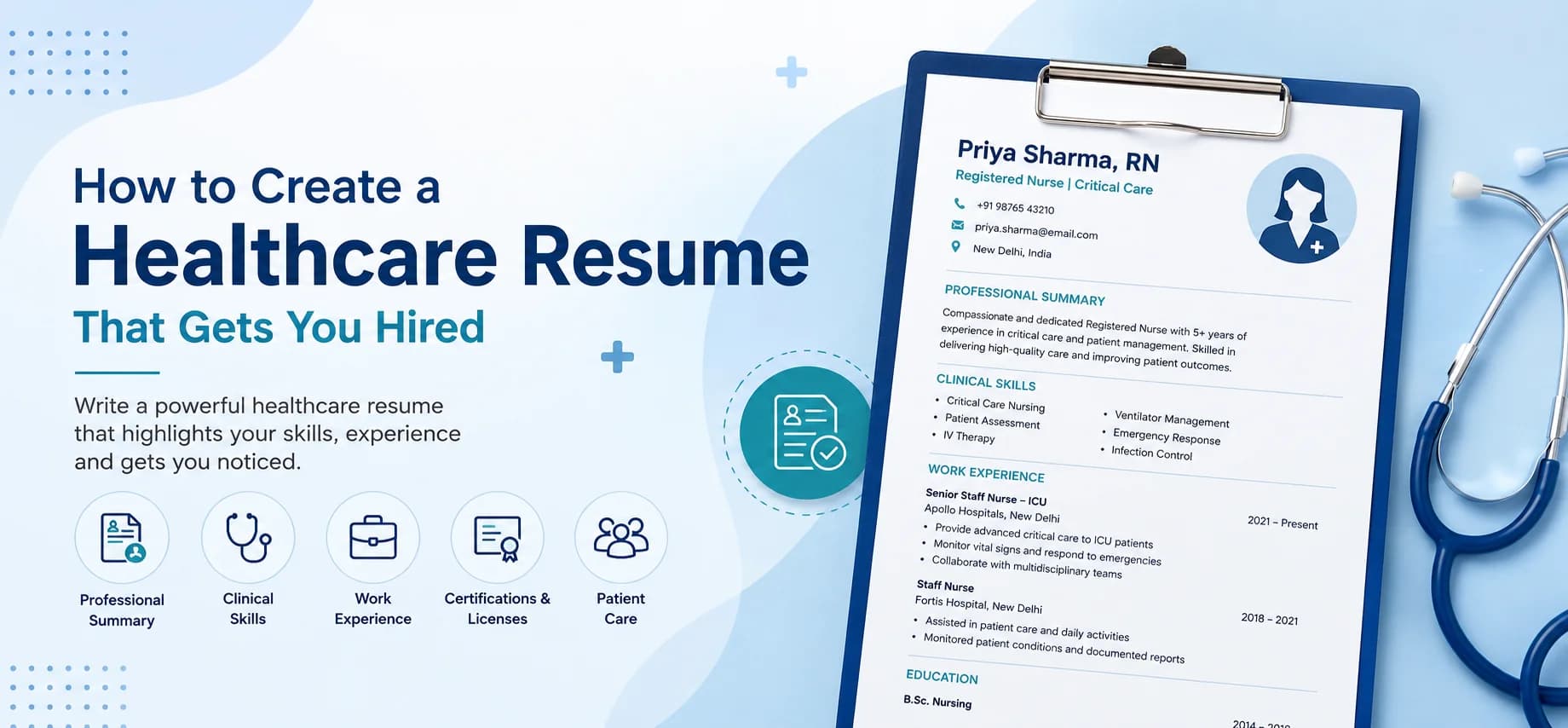
A clear, well-structured resume is often the first impression a hospital recruiter has of you.
A resume can be your biggest career advantage or your biggest barrier.
In healthcare, this matters even more. A recruiter or hospital hiring manager may review dozens or even hundreds of applications for a single position. Before they meet you, your resume is often the first opportunity you have to demonstrate your qualifications, experience, skills, and professional value.
A strong healthcare resume does more than list your education and previous jobs. It tells a clear story about who you are as a healthcare professional, what you can contribute, and why you are suitable for the role.
The question is not simply, “Do you have the right qualifications?” It is:
“Does your resume communicate your qualifications clearly enough to get you shortlisted?”
Is Your CV a Curse or a Boon?
A CV can open a door or quietly close one.
Two healthcare professionals may have similar qualifications and experience, but one may receive an interview call while the other does not. Often, the difference is not their professional capability. It is how effectively their experience is presented.
A recruiter typically needs to understand several things quickly:
- What is your profession?
- What qualifications do you have?
- How much relevant experience do you have?
- What clinical or technical skills do you possess?
- Where have you worked?
- What kind of role are you looking for?
- Are you suitable for the specific position?
If your resume makes these answers difficult to find, the recruiter may move to the next candidate.
Your CV therefore needs to work as a professional introduction before you ever enter the interview room.
What Makes a Healthcare Resume Different?
A healthcare resume is not simply a standard corporate resume with a medical job title added to it.
Healthcare recruitment often involves specific qualifications, registrations, clinical competencies, specialisations, certifications, procedures, hospital exposure, and patient-care responsibilities.
Depending on your profession, recruiters may look for information such as:
- Medical or nursing qualifications
- Professional registrations and licences
- Specialisation
- Clinical experience
- Hospital experience
- Departments worked in
- Procedures and clinical skills
- Certifications
- Emergency-care experience
- Patient-care responsibilities
- Medical software or healthcare technology experience
- Research and publications
- Teaching or academic experience
- Leadership responsibilities
Your resume should therefore be designed around the requirements of the healthcare role you are applying for.
How to Write a Healthcare Resume
A good healthcare resume should be easy to scan, relevant to the position, and focused on evidence rather than unnecessary information.
Here is a practical structure.
1. Start With Your Professional Identity
Your name should be prominent, followed by your professional designation. For example:
- Priya Sharma — Registered Nurse | ICU Nursing | Critical Care
- Dr. Rahul Kumar — MBBS, MD | Internal Medicine
This immediately tells the recruiter who you are professionally. Avoid vague headings such as:
“Looking for a challenging opportunity.”
Instead, communicate your professional identity and area of expertise.
2. Add Relevant Contact Information
Include:
- Phone number
- Professional email address
- City/location
- LinkedIn profile, if relevant
- Professional registration details where appropriate
Avoid unnecessary personal information. Your email address should also look professional. For example:
- Good: firstname.lastname@email.com
- Avoid: cooldoctor123@email.com
Your resume should create a professional impression from the first line.
3. Write a Strong Professional Summary
The professional summary is one of the most important sections of your healthcare resume. It should quickly communicate:
- Your profession
- Years of experience
- Specialisation
- Key strengths
- Type of healthcare environment you have worked in
- What you can contribute
For example:
“Registered Nurse with 5+ years of experience in critical care and emergency nursing, with hands-on experience in ICU operations, patient monitoring, medication administration and multidisciplinary care coordination.”
This is much stronger than:
“Hardworking and dedicated nurse seeking a challenging opportunity.”
The second statement could describe almost anyone. Your summary should explain what makes you relevant to the position.
4. Highlight Your Healthcare Experience
Do not simply list your job title and hospital name. Show what you actually did. Instead of:
“Staff Nurse – ABC Hospital, 2022–2025 — Responsible for patient care.”
Use specific responsibilities and achievements:
- Managed nursing care for patients in a 20-bed critical care unit.
- Monitored vital signs and supported emergency interventions.
- Coordinated with physicians and multidisciplinary healthcare teams.
- Maintained accurate patient documentation and clinical records.
- Supported infection-control and patient-safety protocols.
Whenever possible, quantify your contribution. For example:
“Managed nursing care for 15–20 patients per shift while maintaining accurate clinical documentation and coordinating with multidisciplinary teams.”
Specific information makes your experience more credible.
5. Put Qualifications Clearly
Healthcare recruiters often need to verify educational and professional qualifications quickly. A simple structure works well:
“Qualification | Institution | Year”
For example:
- M.Sc. Nursing – Critical Care — XYZ University | 2022
- B.Sc. Nursing — ABC College of Nursing | 2019
If your profession requires professional registration or licensing, include the relevant registration details where appropriate.
6. Include Relevant Clinical Skills
Your skills section should be tailored to the position. For a nursing role, this could include:
- Critical care nursing
- Patient monitoring
- Medication administration
- IV therapy
- Emergency response
- Infection control
- Patient education
- Clinical documentation
For a medical role:
- Clinical diagnosis
- Patient management
- Emergency medicine
- Specific procedures
- Specialised treatment areas
- Clinical research
- Multidisciplinary care
Avoid filling the section with generic phrases such as:
- Hardworking
- Honest
- Team player
- Positive attitude
These qualities are useful, but your experience should demonstrate them.
7. Use the Right Healthcare Resume Format
The best healthcare resume format is generally clean, chronological and easy to scan. For most healthcare professionals, a reverse-chronological structure works well:
- Name and professional title
- Contact information
- Professional summary
- Key skills
- Professional experience
- Education
- Certifications/licences
- Additional relevant information
For professionals with limited experience, education, internships, clinical rotations and certifications can receive greater emphasis. For experienced professionals, relevant clinical and leadership experience should take priority.
8. Make Your Resume ATS-Friendly
Many organisations use Applicant Tracking Systems (ATS) to help screen applications. An ATS healthcare resume should therefore be easy for both software and humans to read.
Use relevant keywords. If the job description mentions:
- ICU
- Critical Care
- Patient Monitoring
- Emergency Nursing
- Infection Control
…and you genuinely have those skills, use the same terminology naturally in your resume. Do not simply add keywords to manipulate the system.
Continue Your Journey
Not sure where to go next?
Whether you're searching for your next healthcare opportunity or hiring qualified professionals, Nextenti helps you connect with the right people through AI-powered matching.
👩⚕️ Looking for Jobs?
Browse verified healthcare opportunities across hospitals, clinics and healthcare organizations.
Browse Jobs →🏥 Hiring Talent?
Post jobs and receive AI-matched healthcare professionals faster.
Keep the design simple. Avoid:
- Excessive graphics
- Complicated tables
- Multiple text boxes
- Decorative fonts
- Important information inside images
- Unusual symbols
A visually attractive resume is useful only if the important information can still be read easily.
Match the job description. One generic resume may not be the best approach for every application. A nurse applying for an ICU position should emphasise ICU experience. The same nurse applying for a hospital administration position may need to highlight coordination, documentation, team management and administrative responsibilities.
Your resume should reflect the job you want.
9. Use Healthcare CV Tips That Focus on Relevance
One of the simplest ways to improve your resume is to remove information that does not help you get the job.
“Does this information help the recruiter understand why I am suitable for this position?”
If the answer is no, consider removing it. Other useful healthcare CV tips include:
- Keep formatting consistent.
- Use clear headings.
- Start bullet points with strong action words.
- Highlight relevant experience.
- Proofread carefully.
- Use professional language.
- Keep dates consistent.
- Avoid unexplained employment gaps where possible.
- Update your resume regularly.
- Customise it for important applications.
10. Create a Resume Specifically for Hospital Jobs
A resume for hospital jobs should demonstrate your ability to work effectively in a healthcare environment. Depending on the position, hospitals may value:
- Clinical competency
- Patient safety
- Communication
- Teamwork
- Emergency response
- Documentation
- Compliance
- Multidisciplinary coordination
- Patient experience
- Technical skills
- Leadership
For senior positions, also highlight:
- Team size managed
- Department responsibilities
- Operational improvements
- Revenue or productivity impact where relevant
- Quality initiatives
- Accreditation experience
- Training and mentoring
- Leadership achievements
The more senior the position, the more important it becomes to demonstrate impact, rather than simply listing responsibilities.
Nursing Resume Sample Structure
A good nursing resume sample could follow this structure:
- Name — Registered Nurse | ICU | Critical Care
- Contact Information
- Professional Summary — brief 3–4 line summary covering experience, specialisation and key capabilities.
- Core Skills — ICU Nursing, Patient Monitoring, Emergency Care, Medication Administration, Infection Control, Clinical Documentation.
- Professional Experience — Staff Nurse, XYZ Hospital, 2022–Present: managed patient care in a critical care environment, monitored patient conditions and escalated clinical concerns, coordinated with physicians and multidisciplinary teams, maintained clinical documentation and patient records.
- Education — B.Sc. Nursing, ABC University, 2018–2022.
- Certifications — BLS, ACLS, relevant clinical certifications.
- Registration — professional registration/licence details, where applicable.
This structure is simple, professional and easy for recruiters to scan.
Common Healthcare Resume Mistakes
Even qualified healthcare professionals can lose opportunities because of avoidable resume mistakes.
1. Using the Same Resume for Every Job
A resume for an ICU nurse should not look exactly the same as a resume for an outpatient clinic role. Tailor the relevant experience.
2. Writing Long Paragraphs
Recruiters generally need to scan information quickly. Use short bullet points instead of large blocks of text.
3. Listing Responsibilities Without Impact
There is a major difference between:
“Responsible for patient care.”
and:
“Managed patient care for critically ill patients while coordinating with physicians and multidisciplinary teams.”
The second communicates much more.
4. Including Too Much Irrelevant Information
Your childhood achievements, unrelated hobbies and excessive personal information rarely strengthen a healthcare application. Prioritise professional relevance.
5. Ignoring Keywords
If your experience matches the job description but your resume uses completely different terminology, your relevant experience may not be immediately visible. Use accurate industry terminology.
6. Poor Formatting
A resume filled with colours, graphics and complicated layouts may look creative but can become difficult for recruiters and ATS systems to process.
7. Spelling and Grammar Errors
A healthcare professional's resume should demonstrate attention to detail. Proofread before submitting.
8. Not Updating the Resume
Your resume should evolve as your career develops. New certifications, responsibilities, achievements, procedures, publications and leadership experience should be added regularly.
Your Resume Should Tell Your Professional Story
A resume is more than a document.
It is a summary of your professional journey.
For a healthcare professional, that journey may include:
“Education → Clinical Training → Experience → Specialisation → Skills → Leadership → Impact”
A strong resume connects these stages.
Instead of asking:
“How can I make my resume longer?”
ask:
“How can I make my professional value clearer?”
That shift can make a significant difference.
Conclusion
A strong healthcare resume does not guarantee a job—but a weak resume can prevent you from getting the opportunity to demonstrate your capabilities.
Your qualifications, clinical skills and experience matter. But recruiters need to identify those strengths quickly.
Think of your resume as your professional introduction. It should clearly communicate who you are, what you have done, what you are capable of, and why you are relevant to the position.
Whether you are creating a resume for your first hospital job, updating your CV after several years of experience, or applying for a senior healthcare position, focus on clarity, relevance, evidence and accuracy.
Your CV should not be a curse that hides your capabilities. It should be a boon that opens the door to your next healthcare opportunity.
And in a healthcare hiring environment increasingly shaped by technology, the right combination of professional experience, relevant skills and a well-presented resume can help you stand out from the competition.
Once your resume is ready, put it to work — browse verified healthcare job openings on Nextenti and apply with confidence.
Frequently Asked Questions
How do I write a healthcare resume that gets shortlisted?
Highlight your relevant qualifications, experience, skills, and certifications. Tailor your resume to the job description and use relevant keywords.
What should a healthcare resume include?
Include your professional summary, qualifications, experience, skills, certifications, and professional registration details.
How do I make my resume ATS-friendly?
Use simple formatting, standard headings, readable fonts, and relevant job-specific keywords. Avoid excessive graphics and tables.
What are common healthcare resume mistakes?
Avoid generic resumes, irrelevant information, poor formatting, lengthy paragraphs, missing keywords, and spelling or grammar errors.
How long should a healthcare resume be?
Keep it to 1–2 pages for most professionals. Experienced candidates can use more pages if the information is relevant.

About the Author
Rahul Varma
Healthcare Recruitment Specialist
Rahul Varma has spent over 8 years matching allied health professionals and hospital administrators with the right roles across India's fast-growing healthcare sector.
Featured Jobs
Explore latest openings by profession or location
Jobs by Profession
Browse roles by specialty
Jobs by Location
Explore openings by city
Featured Jobs
Explore latest openings by profession or location
Jobs by Profession
Browse roles by specialty
Jobs by Location
Explore openings by city
Keep Reading
You Might Also Like
 Career Guides
D Pharma Career Guide: Salary, Scope & Pharmacist Jobs in India
Learn about D Pharma eligibility, fees, salary, scope, career options and pharmacist jobs in India. Explore opportunities and career growth after D Pharma.

Dr. Meera Iyer
06 Oct 2026
 Lab Technician
Lab Technician Course Guide: MLT, DMLT, Fees, Salary & Jobs in India (2026)
Explore lab technician courses after 12th, DMLT, BSc MLT, eligibility, fees, salary, career scope and lab technician jobs in India.
Arvind Shetty
06 Oct 2026
 Lab Technician
DMLT Salary in India 2026: Per Month Pay, Growth & Lab Jobs
Learn about DMLT salary in India 2026, monthly pay, starting salary, government salary, career scope and the latest DMLT jobs across India.
Priyanka Das
06 Oct 2026