What Makes a Strong Healthcare CV?

Rahul Varma
18 Aug 2026 · 12 min read
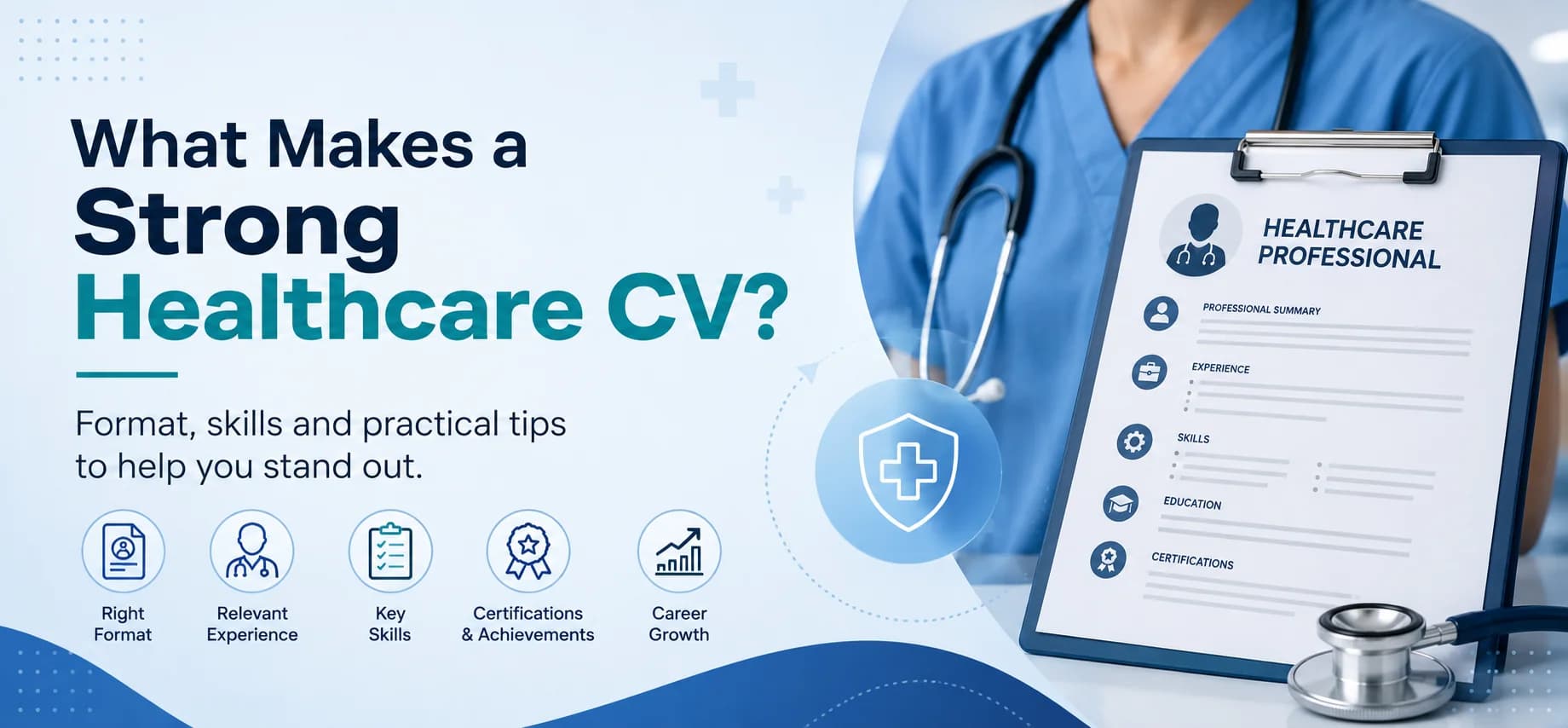
Every CV is a life story — a strong healthcare CV connects your education, experience and skills into one clear professional narrative.
Every CV is a life story.
For a healthcare professional, a CV is more than a document submitted with a job application. It is a professional story that brings together education, clinical experience, responsibilities, skills, achievements, continuous learning and career growth.
A doctor's journey is different from a nurse's. A pharmacist's experience is different from that of a medical laboratory professional. A hospital administrator or healthcare IT professional may have an entirely different career path.
But the purpose of a healthcare CV remains the same: to help a recruiter understand the professional behind the qualifications.
A strong CV should answer a simple question:
“What can this healthcare professional bring to our organisation?”
That is why a CV should not simply list everything you have done. It should present your experience in a way that makes your professional capabilities clear, relevant and easy to understand.
What Makes a Strong Healthcare CV?
A strong healthcare CV is clear, relevant, accurate and focused on the position you are applying for.
It should communicate:
- Your professional identity
- Educational qualifications
- Clinical or professional experience
- Relevant healthcare CV skills
- Certifications and registrations
- Professional achievements
- Leadership responsibilities
- Continuous learning
- Career progression
The strongest CVs do not necessarily contain the most information. They contain the right information.
For example, instead of writing:
“Hardworking and dedicated healthcare professional with excellent communication skills.”
A stronger approach would be:
“Registered Nurse with five years of experience in critical care, with expertise in patient monitoring, medication administration, infection prevention and multidisciplinary care coordination.”
The second example gives the recruiter something specific to understand.
Your Healthcare CV Should Tell Your Career Story
A healthcare career develops over time.
You may start with a professional qualification, enter clinical practice, develop specialised skills, take on additional responsibilities, move into leadership and continue learning throughout your career.
Your healthcare CV should reflect that progression.
Think of it as a professional timeline:
“Education → Experience → Skills → Responsibility → Achievement → Growth”
This approach makes your CV more meaningful than simply listing job titles and dates.
For example, instead of:
“Staff Nurse – XYZ Hospital – 2021–2025”
you could explain:
“Worked as a Staff Nurse in a 40-bed medical unit, managing patient monitoring, medication administration, clinical documentation and coordination with multidisciplinary teams.”
Now the recruiter can understand the professional experience behind the job title.
Choose the Right Medical CV Format
There is no single medical CV format that works for every healthcare professional.
The structure should reflect your profession, experience level and the position you want.
Medical CV Format for Doctors
A doctor's CV may include:
- Name and professional designation
- Contact information
- Professional summary
- Specialisation
- Medical registration
- Clinical experience
- Medical education
- Fellowships and specialised training
- Certifications
- Clinical procedures
- Research experience
- Publications
- Conferences and presentations
- Teaching experience
- Awards
- Professional memberships
For experienced doctors, research, publications, teaching, leadership and specialised clinical experience can become particularly important.
Medical CV Format for Nurses
A CV for doctors and nurses should not necessarily follow the same structure.
A nursing CV can highlight:
- Nursing qualifications
- Professional registration
- Clinical departments
- Patient-care experience
- Clinical competencies
- Emergency response
- Infection prevention
- Patient safety
- Medication administration
- Patient education
- Team coordination
- Leadership responsibilities
- Certifications
- Continuing professional development
The most effective structure is the one that makes the candidate's relevant experience easiest to understand.
Highlight the Right Healthcare CV Skills
The healthcare CV skills you highlight should be relevant to the position.
For clinical professionals, these may include:
- Patient assessment
- Clinical documentation
- Medication administration
- Patient monitoring
- Infection prevention and control
- Emergency response
- Clinical procedures
- Care coordination
- Patient education
- Multidisciplinary collaboration
For healthcare administrators:
- Hospital operations
- Workforce management
- Quality management
- Patient experience
- Process improvement
- Healthcare analytics
- Regulatory compliance
- Financial management
- Team leadership
- Strategic planning
For healthcare technology professionals:
- Health informatics
- Healthcare information systems
- Data analytics
- Digital health
- Artificial intelligence
- Process automation
- Project management
- Data interpretation
Do not create a long list simply to make your CV look impressive.
Ask:
“Which skills are most relevant to the role I want?”
Those skills should receive greater visibility.
Show Experience, Not Just Job Titles
One of the biggest mistakes in a healthcare CV is providing only job titles and responsibilities.
For example:
“Senior Nurse — Responsible for patient care and team coordination.”
This is too general.
Instead:
“Senior Nurse — Coordinated patient care across a 30-bed unit, supported junior nursing staff, monitored clinical documentation and worked with multidisciplinary teams to maintain continuity and quality of care.”
The second version provides context.
Whenever possible, explain:
- What you were responsible for
- Who you worked with
- What type of patients or environment you worked in
- What skills you used
- What additional responsibilities you handled
- What you improved or achieved
This makes your experience more valuable to the recruiter.
Highlight Achievements on Your Healthcare CV
Responsibilities tell recruiters what you were expected to do.
Achievements show what you contributed.
For example:
Responsibility:
“Managed a nursing team.”
Achievement-focused description:
“Led a 20-member nursing team and supported improvements in shift coordination, staff communication and continuity of patient care.”
Where appropriate, use measurable information such as:
- Number of patients
- Number of beds
- Team size
- Departments managed
- Projects completed
- Training sessions conducted
- Process improvements
- Quality improvements
Not every healthcare achievement needs a number. However, relevant evidence can help recruiters understand the scale and impact of your work.
Continuous Learning Belongs on Your Healthcare CV
Healthcare is constantly changing.
New technologies, clinical practices, healthcare systems and treatment approaches continue to develop. Professionals therefore need to keep learning throughout their careers.
Your CV should reflect that mindset.
Include relevant:
- Certifications
- Fellowships
- Workshops
- Continuing professional development
- Specialised clinical training
- Leadership programmes
- Technology training
- Conferences
- Academic courses
A professional who demonstrates continuous learning communicates something important to a potential employer:
“I am not only experienced; I am also prepared to keep developing.”
This is especially important as healthcare organisations increasingly adopt technology, data-driven decision-making and new models of care.
Make Your Healthcare CV Easy to Read
Recruiters may review many applications for a single position.
Your CV should therefore be easy to scan.
Use:
- Clear headings
- Short paragraphs
- Bullet points
- Consistent formatting
- Logical dates
- Professional fonts
- Appropriate spacing
- Clear section titles
Avoid:
- Excessive graphics
- Decorative fonts
- Very long paragraphs
- Too many colours
- Repeated information
- Irrelevant personal details
- Unsupported claims
A professional healthcare CV does not need complicated design.
Clarity makes your experience easier to recognise.
Continue Your Journey
Not sure where to go next?
Whether you're searching for your next healthcare opportunity or hiring qualified professionals, Nextenti helps you connect with the right people through AI-powered matching.
👩⚕️ Looking for Jobs?
Browse verified healthcare opportunities across hospitals, clinics and healthcare organizations.
Browse Jobs →🏥 Hiring Talent?
Post jobs and receive AI-matched healthcare professionals faster.
Tailor Your Healthcare CV to the Job
A common mistake is sending exactly the same CV for every healthcare position.
Your overall career history may remain the same, but the emphasis should change depending on the opportunity.
For example, consider a nurse applying for three positions:
ICU Nurse
Emphasise:
- Critical care experience
- Patient monitoring
- Emergency response
- Clinical procedures
- High-acuity patient management
Nurse Educator
Emphasise:
- Teaching
- Training
- Mentoring
- Staff development
- Clinical education
Nursing Leadership Role
Emphasise:
- Team management
- Workforce coordination
- Quality improvement
- Operational responsibilities
- Leadership experience
This is not about changing your career story.
It is about making the most relevant part of your story visible.
Healthcare CV Sample: Recommended Structure
If you are looking for a healthcare CV sample, the following structure is a practical starting point.
1. Professional Header
- Name
- Professional designation
- Phone | Email | Location | Professional profile
2. Professional Summary
Briefly describe your profession, experience, specialisation and career focus.
3. Key Skills
List the most relevant healthcare CV skills for the position.
4. Professional Experience
For every position, include:
“Job Title | Organisation | Location | Dates”
Then describe:
- Key responsibilities
- Relevant clinical or functional experience
- Achievements
- Leadership or additional responsibilities
5. Education
Include relevant degrees, diplomas and institutions.
6. Certifications and Registrations
Include professional registration and relevant certifications.
7. Additional Professional Experience
Depending on your profession, include:
- Research
- Publications
- Teaching
- Conferences
- Professional memberships
- Awards
- Leadership activities
This structure can be adapted for doctors, nurses, pharmacists, technicians, healthcare administrators and other healthcare professionals.
How to Improve Your Healthcare CV
If your CV is not generating the opportunities you expect, the solution may not always be adding more information.
Sometimes, you need to improve how your existing experience is presented.
Here is how to improve your healthcare CV effectively.
Replace generic statements
Instead of:
“Excellent communication skills.”
Write:
“Coordinated communication between patients, families and multidisciplinary clinical teams during inpatient care.”
Focus on relevant experience
Not every job responsibility needs equal space. Give more visibility to experience that directly relates to your target position.
Use evidence
Where appropriate, include numbers, outcomes or examples that demonstrate your contribution.
Update your skills
Healthcare professionals should regularly review their skills, certifications and professional development.
Remove unnecessary information
A CV should be focused. If a section does not help the recruiter understand your suitability, consider removing or reducing it.
Keep your career story consistent
Your CV and professional profiles should present an accurate and consistent picture of your career.
Update your CV regularly
Do not wait until you start searching for a new job. Every new certification, project, leadership responsibility, publication, training programme or significant achievement can become part of your professional story.
What Recruiters Should Understand From Your CV
Before submitting your CV, read it from the recruiter's perspective.
Ask yourself:
- Can they understand my profession immediately?
- Can they identify my level of experience?
- Can they see my relevant skills?
- Can they understand what I have achieved?
- Does my experience match the job?
- Can they see evidence of professional growth?
- Are my qualifications and registrations easy to find?
If the answers are yes, your CV is doing what it should.
A strong CV reduces the effort required to understand your professional value.
Your CV Is More Than a List of Qualifications
A healthcare career is built through many experiences.
There are examinations completed, patients cared for, teams supported, difficult situations handled, new skills learned, responsibilities accepted and lessons gained.
Your CV cannot include every moment of that journey.
But it should capture the experiences that best explain who you are as a healthcare professional today.
That is why every CV is a life story.
The goal is not to fill your CV with impressive words.
The goal is to make your professional journey clear, credible and relevant.
Your CV should connect your education with your experience, your experience with your skills, and your skills with the value you can bring to a healthcare organisation.
A strong healthcare CV does not simply tell a recruiter where you have worked.
It helps them understand what you have learned, what you can do and what you can contribute next.
Final Thought
Every CV is a life story.
Your healthcare CV should tell that story with clarity.
It should show where you started, what you have learned, what you have accomplished and what you are capable of contributing next.
Because behind every qualification is a professional journey.
Your career is the story. Your CV is how you tell it.
Ready to put your CV into practice? Read our Healthcare Resume Guide and browse healthcare job openings on Nextenti.
Frequently Asked Questions
What makes a strong healthcare CV?
A strong healthcare CV is clear, relevant, accurate and tailored to the position. It should highlight your qualifications, professional experience, healthcare CV skills, certifications, achievements and continuous professional development.
What sections should a healthcare CV have?
A healthcare CV generally includes a professional header, professional summary, key skills, professional experience, education, certifications and professional registrations. Depending on your profession, you can also include research, publications, teaching, conferences, awards and professional memberships.
How is a CV different from a resume?
A CV traditionally provides a broader record of your academic and professional journey, while a resume is usually a shorter and more targeted summary of experience and skills. However, the terms are often used interchangeably depending on the country and industry.
What skills should I highlight on a healthcare CV?
Highlight skills that are relevant to the position you are applying for. These may include clinical competencies, patient care, communication, teamwork, leadership, quality improvement, healthcare technology, administration, research or specialised procedures.
How do I make my CV stand out to recruiters?
Make your CV easy to understand. Clearly communicate your professional identity, tailor your experience to the role, highlight relevant skills, demonstrate achievements and use a clean structure. Avoid generic statements and focus on evidence of your capabilities.

About the Author
Rahul Varma
Healthcare Recruitment Specialist
Rahul Varma has spent over 8 years matching allied health professionals and hospital administrators with the right roles across India's fast-growing healthcare sector.
Featured Jobs
Explore latest openings by profession or location
Jobs by Profession
Browse roles by specialty
Jobs by Location
Explore openings by city
Featured Jobs
Explore latest openings by profession or location
Jobs by Profession
Browse roles by specialty
Jobs by Location
Explore openings by city
Keep Reading
You Might Also Like
 Career Guides
D Pharma Career Guide: Salary, Scope & Pharmacist Jobs in India
Learn about D Pharma eligibility, fees, salary, scope, career options and pharmacist jobs in India. Explore opportunities and career growth after D Pharma.

Dr. Meera Iyer
06 Oct 2026
 Lab Technician
Lab Technician Course Guide: MLT, DMLT, Fees, Salary & Jobs in India (2026)
Explore lab technician courses after 12th, DMLT, BSc MLT, eligibility, fees, salary, career scope and lab technician jobs in India.
Arvind Shetty
06 Oct 2026
 Lab Technician
DMLT Salary in India 2026: Per Month Pay, Growth & Lab Jobs
Learn about DMLT salary in India 2026, monthly pay, starting salary, government salary, career scope and the latest DMLT jobs across India.
Priyanka Das
06 Oct 2026