Doctor Jobs in India: How to Find the Right Opportunity

Sanjay Kagitha
10 Nov 2026 · 14 min read

Hospital owners and HR heads often assume that India has enough doctors, so hiring should be straightforward.
For anyone searching for doctor jobs in India, the truth is that the best opportunity is rarely the one with the loudest name or the biggest advertised salary.
For hospital owners and HR managers, that means competing for scarce specialists, especially outside the metros.
For doctors, it means a market where the best opportunity is rarely the one with the loudest name or the biggest advertised salary.
This guide covers the main doctor jobs in India, current pay benchmarks, credential verification, a practical hiring process, and how AI-enabled hiring shortens the path from vacancy to joining.
Want to find the best opportunity? Nextenti is an AI-powered healthcare hiring platform that matches verified doctors and professionals to the top vacancies. Create an account or talk to the Nextenti team - to know more!
Types of Doctor Jobs Available in India
Doctor employment in India follows a ladder, and each rung has its own title, duty pattern, and pay band. Knowing which rung a role sits on is the first step to writing a precise job description or searching efficiently.
Pay figures below are monthly and indicative. Government figures come from published pay matrices and 2026 notifications; private-sector figures vary with city, hospital category, and shift load.
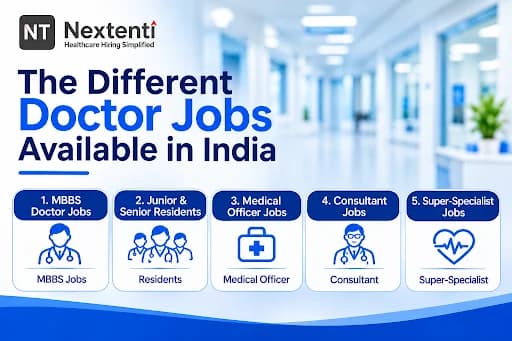
1. MBBS Doctor Jobs in India
With an MBBS, an internship completion certificate and registration with a State Medical Council, a doctor can apply for entry-level clinical work.
Private pay for these roles typically sits between ₹40,000 and ₹75,000 a month, depending on night shifts and location. Contractual National Health Mission (NHM) posts advertised in 2026 pay consolidated amounts of roughly ₹50,000 to ₹1,00,000 a month, depending on the state and programme.
These roles usually involve outpatient consultations, ward rounds and primary care. Typical options include:
- Resident Medical Officer (RMO) in a private hospital or nursing home
- General Duty Medical Officer (GDMO) at a government dispensary or PHC
- Casualty or emergency medical officer
2. Junior and Senior Resident Doctor Jobs
Residents are the backbone of any teaching hospital. Junior residents are doctors in their three-year MD, MS, or DNB training. Stipends are set by states and institutions and vary widely: NMC data have shown a spread from about ₹15,000 to ₹1.25 lakh a month across colleges.
Senior residents have completed the postgraduate degree. At AIIMS and other central institutes, the post sits at Pay Level 11 of the 7th CPC matrix, with entry basic pay of ₹67,700 plus non-practising allowance and other allowances, usually under a tenure of up to three years.
Senior residency is also one of the routes to becoming an Assistant Professor under the NMC’s 2025 faculty regulations.
Selection is through a competitive exam or direct interview, so candidates should keep their documents ready. Most of these posts are in teaching hospitals and government medical colleges.
3. Medical Officer and Duty Doctor Jobs in India
Medical Officer posts are the regular civil-service side of medicine. Officers run OPDs, handle inpatient care, support national health programmes such as TB elimination and cover emergencies, mostly in community health centres, district hospitals and PSU townships.
Recruitment usually runs through the UPSC Combined Medical Services examination or a State Public Service Commission. Duty doctors in private hospitals do something different: ICU cover, night shifts and emergency triage, with pay shaped by hospital size and shift length.
Government posts suit candidates who want stability; private duty roles suit those who want faster entry and shift flexibility.
4. Consultant and Specialist Doctor Jobs
Consultants are specialists with an MD, MS or DNB plus post-qualification experience. They manage patients independently, lead inpatient teams and work alongside multidisciplinary groups.
Entry-level consultants earn about ₹1.2 lakh to ₹2.5 lakh a month. Five to ten years of experience typically moves that to ₹2.5 lakh to ₹5 lakh, and senior consultants with ten or more years can reach about ₹6 lakh. The speciality decides which departments will want the doctor.
Private hospitals typically hire in three ways:
- Full-time salaried roles
- Revenue-sharing arrangements, commonly 50% to 70% of consultation and procedure fees in the doctor’s favour
- Visiting consultant contracts
5. Super-Specialist Doctor Jobs in India
Super-specialists hold a DM, MCh or DrNB, the highest level of clinical training in India. Demand comes from cardiac institutes, cancer centres and transplant programmes, so careers in cardiology, neurology, neurosurgery, oncology and gastroenterology lead the hiring list.
The training path is long, but sustained demand keeps compensation high. In tertiary-care hospitals, they handle advanced procedures such as complex coronary interventions or liver transplant evaluations.
Starting salaries in private tertiary centres typically range from ₹3.5 lakh to ₹6 lakh a month.
For senior, procedure-heavy super-specialists, pay can range from ₹8 lakh to over ₹15 lakh a month, with procedure share making up much of the top end.
Medical Specialities and Career Opportunities
Choosing a speciality is the biggest career decision after MBBS, and for employers it determines which vacancies are hardest to fill.
We have grouped the medical specialities below into clinical, surgical, and diagnostic and critical care, so the day-to-day work and pay of each can be compared. For deeper profiles, see Nextenti’s Speciality Guides.
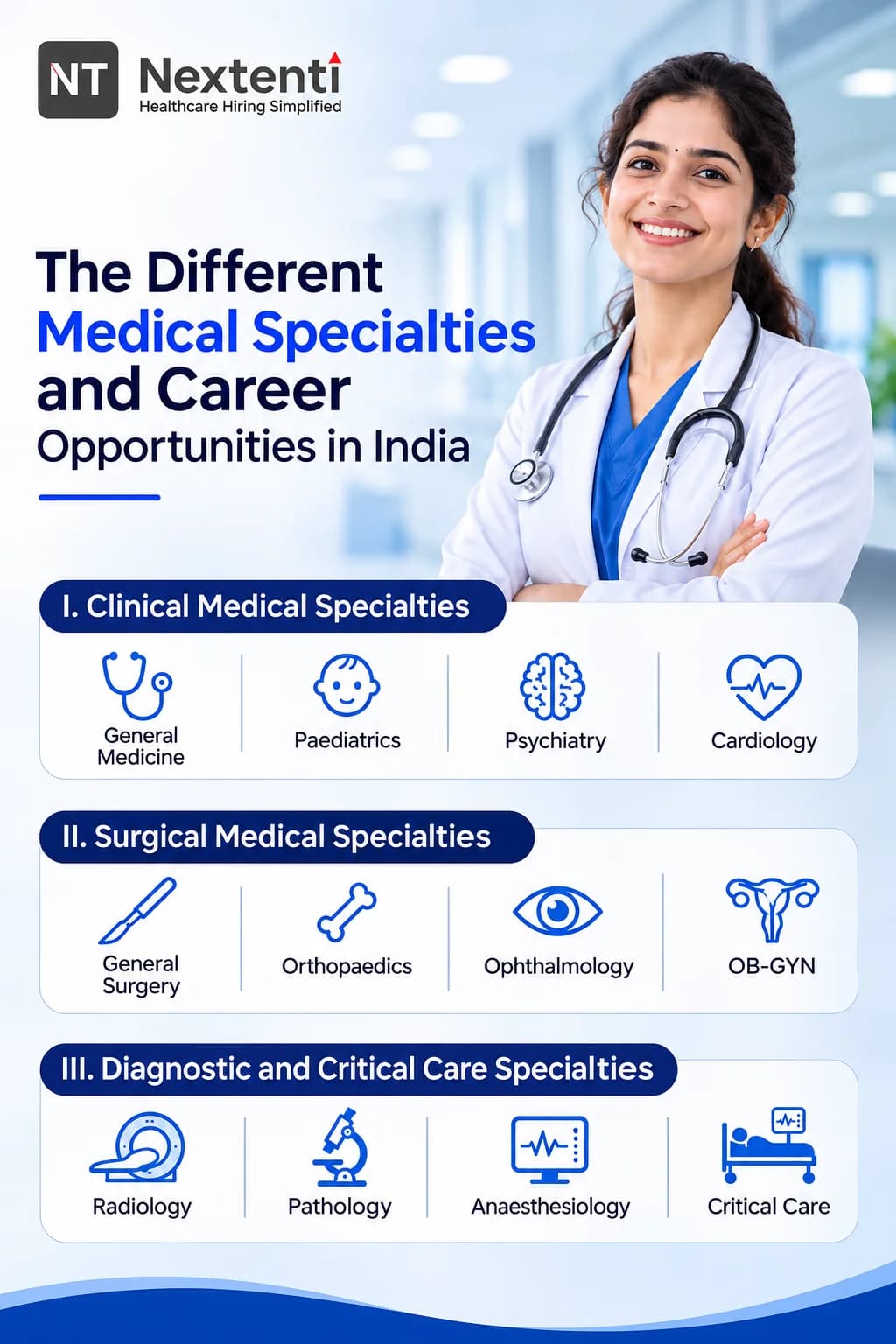
1. Clinical Medical Specialities
Clinical specialities focus on diagnosis, medication and long-term care. General medicine (MD or DNB) is the gateway, paying roughly ₹1.5 lakh to ₹4 lakh a month.
Paediatrics and psychiatry sit around ₹1.3 lakh to ₹3.5 lakh, while dermatology offers strong private practice potential.
Demand for psychiatry is growing across metro and tier-2 city hospitals, and the rising burden of diabetes and hypertension is lifting demand for nephrology and endocrinology.
Cardiology, neurology, nephrology, endocrinology and gastroenterology need a DM or DrNB after an MD, but the payoff is larger: consultant cardiologists commonly earn ₹3.5 lakh to ₹10 lakh a month.
2. Surgical Medical Specialities
Surgical specialities demand procedural skill, long hours and calm under pressure. General surgery (MS or DNB) is the foundation, paying about ₹1.5 lakh to ₹4 lakh a month.
Orthopaedics, ophthalmology, ENT, and obstetrics and gynaecology fall mostly between ₹1.4 lakh and ₹6 lakh. Orthopaedics is driven by road accident volumes and ageing demographics, while ophthalmology offers strong outpatient surgical potential.
Urology, plastic surgery and neurosurgery need an MCh on top, and neurosurgery can reach ₹12 lakh or more. Obstetrics and gynaecology is known for continuous emergency duty, so duty rosters and compensation should reflect it.
3. Diagnostic and Critical Care Specialities
These specialities keep the hospital running behind the scenes. Radiology offers flexible teleradiology options: 2026 public salary surveys put salaried consultants at roughly ₹1.25 lakh to ₹2 lakh a month, while subspecialists and per-study reporters can earn considerably more. Pathology and microbiology run lower, around ₹1 lakh to ₹3 lakh.
Anaesthesiology, emergency medicine, and critical care are heavily recruited by corporate hospitals for ICU and emergency cover.
Critical care usually needs a DM, DrNB or FNB after an MD or DNB. Nuclear medicine, which involves PET-CT and radionuclide therapy, is a smaller niche.
Many of these roles are hospital-based, which suits doctors who would rather not run a clinic.
Doctor Salaries in India: What Can You Expect?
Salary is usually the first thing candidates search for and the first thing employers must benchmark. The question most people ask is what doctor salaries in India look like in practice.
The answer depends on more than base pay. Private jobs often add consultation fees and incentives, while government pay follows a fixed matrix.
Continue Your Journey
Not sure where to go next?
Whether you're searching for your next healthcare opportunity or hiring qualified professionals, Nextenti helps you connect with the right people through AI-powered matching.
👩⚕️ Looking for Jobs?
Browse verified healthcare opportunities across hospitals, clinics and healthcare organizations.
Browse Jobs →🏥 Hiring Talent?
Post jobs and receive AI-matched healthcare professionals faster.
Candidates and employers should both ask what is guaranteed and what is variable.
Salary Expectations for Doctors by Qualification and Experience
Here’s a realistic snapshot of monthly pay. Here, one point we’d ask you to look at is how the pay climbs once you add a postgraduate degree.
Established consultants may also earn through consultation fee splits, typically 50:50 to 70:30 in the doctor’s favour.
Your own offer will move up or down with location and hospital category.
| Role | Typical monthly pay |
|---|---|
| Entry-level MBBS or duty doctor | ₹40,000 – ₹75,000 |
| Senior resident or medical officer | ₹80,000 – ₹1,40,000 |
| Junior consultant (0–5 years) | ₹1.2 lakh – ₹2.5 lakh |
| Senior consultant (10+ years) | ₹2.5 lakh – ₹6 lakh |
| Super-specialist (DM/MCh) | ₹3.5 lakh – ₹15 lakh+ |
What are the Highest-Paying Medical Specialities in India?
If income is your priority, procedure-heavy specialties lead the table.
Senior interventional cardiologists in corporate hubs earn about ₹5 lakh to ₹15 lakh a month, and experienced neurosurgeons earn ₹4.5 lakh to ₹12 lakh, making these two fields the highest.
After this, typical salaries for other specialties:
- Surgical oncology (₹4 lakh to ₹11 lakh monthly)
- Orthopaedics (₹3.5 lakh to ₹10 lakh monthly)
- Gastroenterology (₹3.5 lakh to ₹9 lakh monthly)
- Radiology (₹2.5 lakh to ₹7 lakh monthly)
That said, these figures depend on experience and the institution, and high pay usually comes with high-risk procedures and heavy call duty.
How to Find Doctor Jobs in India
Doctors in India typically land jobs through four routes: hospital career pages and job portals, government notifications, professional networks, and recruitment agencies.
Employers use the same four routes to fill doctor vacancies in India, and each route suits a different type of vacancy. Fake or fee-charging listings remain a risk, so every source should be verified.
1. Hospital Career Pages and Online Job Portals
Start at the source. Chains such as Apollo, Fortis, Max and Manipal post consultant and fellowship openings on their own career pages, and government doctor vacancies in India appear on upsc.gov.in, esic.gov.in, state PSC portals and individual AIIMS websites.
LinkedIn Jobs and Naukri.com let candidates filter by speciality, experience, and city.
Healthcare-specific platforms gather verified vacancies from hospitals, nursing homes, diagnostic chains and clinics.
Nextenti’s doctor listings are an ideal site that caters exclusively to doctors and healthcare organizations.
Candidates should set job alerts for their speciality and preferred city and check notification dates weekly. Employers should publish complete, specific postings.
2. Medical Recruitment Agencies and Professional Networks
Agencies and networks matter most at consultant level and for hard-to-fill medical specialities. Healthcare executive search firms place department heads and super-specialists in corporate networks.
Professional bodies such as the Indian Medical Association (IMA) and the Association of Physicians of India (API) run job boards and conference networking, and alumni groups from colleges like AIIMS, CMC Vellore and KGMU often provide referrals.
One rule is non-negotiable: genuine healthcare recruitment in India is employer-funded, so candidates should avoid any agency asking for a placement fee and should verify a recruiter before sharing documents. Employers should confirm fee terms, replacement guarantees, and whether the agency verifies credentials or merely forwards CVs.
How to Apply for Doctor Vacancies in India Successfully
A strong application is mostly paperwork done right. Keep these ready:
- A CV highlighting procedure logs, case volumes and publications
- MBBS and postgraduate degree certificates
- Permanent State Medical Council registration
- Your National Medical Register ID
- Internship completion certificate and experience letters
Surgical and interventional roles also expect a procedural logbook. Hospitals will verify credentials and references before the interview stage ends, so make sure every date matches across documents.
Then prepare for the interview by revisiting your recent cases, clinical audits and publications.
How to Choose the Right Doctor Job in India
Weigh compensation, patient volume, infrastructure, working hours, location, institutional reputation, and long-term growth.
Focusing only on pay is the easiest mistake to make, and because doctor salaries in India vary so widely, the more useful questions are what the job demands every day and where it leads in five years. Hospitals that answer both clearly win more offers and are the ideal ones to join.
1. Look at Salary, Benefits and Working Conditions
Look past the headline figure. Ask for the split between fixed pay and incentives, and clarify weekly duty hours, night shifts, and on-call obligations. Also check:
- Whether the hospital covers professional indemnity insurance
- Notice period and exit terms (typically one to three months)
- Accommodation, insurance and leave policies
- Whether the position is contractual or permanent
Are Non-Compete Clauses Enforceable for Doctors in India?
Post-termination non-compete clauses are generally void under Section 27 of the Indian Contract Act, 1872, because they restrain a lawful profession.
However, there are often restrictions during employment, and confidentiality obligations that stand on firmer ground. Employers often draft contracts around this, so these details are worth paying attention to.
Some contracts also restrict private practice within 5 to 10 kilometres for one to two years after you leave. Read the clause line by line before signing.
2. Look at Career Growth and Professional Development
A good job should offer career growth opportunities for doctors in India, not just a higher salary. Candidates look at case mix and access to advanced technology such as robotic surgery and cath labs, and ask about clinical mentorship and CME support, including paid leave for conferences.
Doctors who plan to teach check that the hospital holds NMC or NBEMS accreditation for postgraduate training, so they can become recognised PG guides.
You should also ask about the leadership path from junior consultant to senior consultant, department chair or medical director.
These are the things a salary figure never shows.
How Nextenti Helps Doctors Find the Ideal Jobs and Hospitals Find the Right Talent
Healthcare recruitment in India usually means choosing between hospital career pages, job portals, agencies, and word of mouth, on both sides of the table.
Nextenti is an AI-powered healthcare hiring platform that replaces that issue with one verified profile for the doctor and one hiring dashboard for the hospital, across 19 healthcare sectors.
For Doctors: Find the Job That Fits Your Career and Your Life
Nextenti is free for job seekers. Build one profile by uploading a PDF or DOCX resume or entering your details manually, then set your speciality, preferred locations, shifts and availability. Here is what that gets you:
- Matches, not noise. AI matches your profession, skills, experience and preferred locations with relevant openings and shows match scores, so the best-fit roles come first instead of thousands of listings.
- Every work format in one place. Full-time, part-time, consultancy, locum, shift-based, freelance and remote roles sit on one platform, which suits consultants who combine hospital work with private practice.
- Real-time alerts. You are notified when a relevant role goes live, so you can apply before the vacancy fills.
- Confidential, mobile-first search. Search, apply and track applications from the Nextenti app on iOS and Android.
- Cities you can target. Current openings are listed in Hyderabad, Bengaluru, Chennai, Kochi, Visakhapatnam and Rangareddy.
Keep your registration details, degrees, and procedure experience handy when you build the profile; a complete profile gives hospitals more to go on.
You can then browse current doctor jobs in India by speciality and city.
Ready to find the right opportunity without endless searching? We’d strongly recommend you create a profile with Nextenti today!
Featured Jobs
Explore latest openings by profession or location
Jobs by Profession
Browse roles by specialty
Jobs by Location
Explore openings by city
Featured Jobs
Explore latest openings by profession or location
Jobs by Profession
Browse roles by specialty
Jobs by Location
Explore openings by city
Keep Reading
You Might Also Like
 Healthcare Hiring
Nursing Recruitment in India: How Hospitals Can Find and Hire Qualified Nurses
Explore nurse recruitment in India, including nursing qualifications, hospital staffing requirements, hiring channels, recruitment costs and AI hiring solutions.

Srikanth
12 Nov 2026
 Healthcare Jobs
Nursing Jobs in India: Roles, Eligibility, and Opportunities for Nurses
Explore nursing careers in India, including job opportunities, qualifications, eligibility, salaries, specialisations and overseas nursing jobs.
Meghana Ballekari
12 Nov 2026
 Healthcare Hiring
How to Hire Qualified Doctors in India: A Guide for Hospitals and Healthcare Organisations
Learn how hospitals in India can hire qualified doctors. Explore recruitment channels, credential verification, hiring steps, costs and AI-powered hiring.
Sumitha Kini
10 Nov 2026