Nursing Recruitment in India: How Hospitals Can Find and Hire Qualified Nurses

Srikanth
12 Nov 2026 · 13 min read
The most important number in nursing recruitment is rarely the largest one. India lists more than 4.6 million registered nursing personnel, yet only about 790,000 are estimated to be actively practising.
For a hospital owner, HR manager or Chief Nursing Officer, that gap explains why ICU and OT vacancies stay open for weeks while hundreds of resumes arrive.
This guide shows how to verify credentials, match nurses to departments, build a structured hiring process and control costs, and how a specialised platform such as Nextenti can simplify each step.
Why Is Nursing Recruitment a Challenge for Hospitals in India?
Hospitals need more specialised clinical nurses than the market can currently supply. Every unfilled ICU, emergency, or operation theatre post affects patient safety, bed utilisation, and the workload of the nurses already on duty.
Filling critical care vacancies frequently takes 45 to 60 days, which is long enough to hold back a new unit or force overtime across existing teams.
The sections below explain why the shortage persists and where hospitals can respond.
How Does India's Nursing Workforce Compare with Hospital Demand?
Education capacity has grown. India has 5,253 INC-recognised nursing institutions producing approximately 387,000 nursing graduates a year, and combined GNM and B.Sc. Nursing seats rose from 199,036 in 2014 to 277,331 in 2024–25, an increase of 39.4%.
The difficulty lies between the register and the ward. Of an estimated stock of 2.18 million nurses, fewer than 800,000 practise in the domestic system, a participation rate of about 36%.
What Challenges Do Hospitals Face When Hiring Nurses?
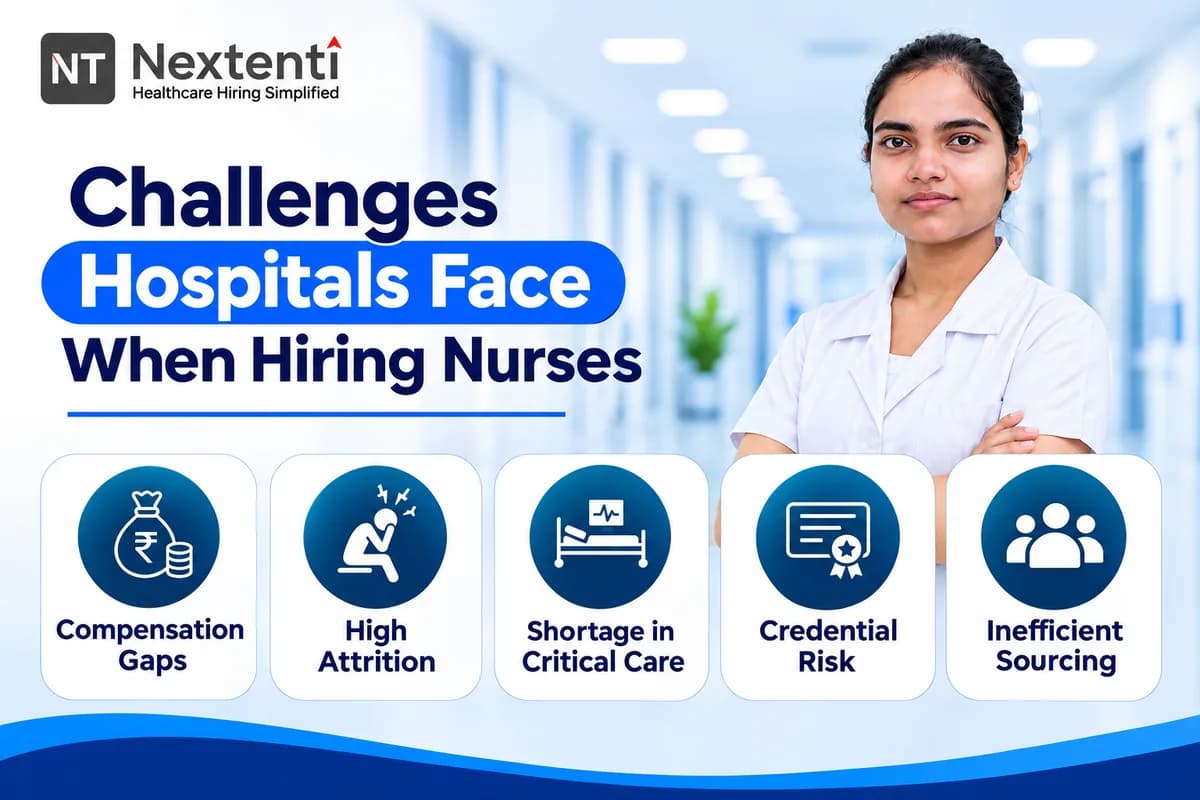
Five challenges recur across Indian hospitals, and they reinforce one another.
- Compensation gaps between sectors. Entry-level staff nurses at central government hospitals such as AIIMS or ESIC start at Pay Level 7 with a basic pay of ₹44,900 a month, and gross monthly pay of ₹65,000 to ₹82,000. Entry-level nurses in Tier-2 and Tier-3 private hospitals often start at ₹10,000 to ₹15,000.
- High attrition and burnout. 87.1% of staff nurses report a high perceived workload and 45% express an intention to leave. Ward ratios of 1:18 or 1:20 in non-accredited private hospitals accelerate exhaustion, and annual turnover in private nursing units runs between 15% and 35%.
- Shortages in critical care. Nurses with verified ICU, NICU, OT, and emergency competence, valid ACLS credentials, and hands-on ventilator experience need extensive screening.
- Credential risk. Unaccredited nursing institutions make verification essential, and unverified paper documents create compliance and clinical risk.
- Inefficient sourcing. Generic job portals and walk-in drives generate large volumes of unqualified applicants, which lengthens vacancies and raises cost per hire.
What Qualifications and Registrations Should Hospitals Verify Before Hiring Nurses?
Nursing education and registration are regulated by the Indian Nursing Council (INC) and State Nursing Councils.
The National Nursing and Midwifery Commission (NNMC) Act, 2023 replaces the Indian Nursing Council Act of 1947 and keeps the core rule in place: no nurse may practise clinically without active registration on a State Register as a Registered Nurse and Registered Midwife (RN/RM).
Verification is therefore a patient-safety and legal task, not an administrative formality. The two subsections below cover what each qualification qualifies a nurse to do and how to confirm that the credentials are genuine.
Which Nursing Qualifications Are Accepted by Indian Hospitals?
Indian hospitals employ nurses across four educational tiers. Match the qualification to the clinical responsibilities of the vacancy.
| Qualification | Duration | Academic eligibility | Typical hospital roles |
|---|---|---|---|
| GNM (General Nursing and Midwifery) | 3 years (diploma) | 10+2 with English, minimum 40% aggregate; Science stream preferred | Staff Nurse in general wards, outpatient departments, minor OTs and step-down wards |
| B.Sc. Nursing | 4 years (degree) | 10+2 with Physics, Chemistry, Biology and English, minimum 45–50% aggregate | Staff Nurse, Senior Staff Nurse, Critical Care Nurse, Shift In-Charge, Clinical Tutor |
| Post Basic B.Sc. Nursing | 2 years (degree completion) | Registered GNM holder with valid State Nursing Council RN/RM registration | Senior Staff Nurse, Unit Supervisor, Specialty Nurse, Clinical Instructor |
| M.Sc. Nursing | 2 years (postgraduate) | B.Sc. or Post Basic B.Sc. plus at least 1 year of clinical experience | Nurse Specialist, Clinical Nurse Specialist, Nursing Supervisor, Assistant Nursing Superintendent |
Use GNM for ward-based roles, and look to B.Sc. and above for critical care and supervisory posts. Experience requirements should sit on top of the qualification, not replace it.
How Can Hospitals Verify Nursing Registration and Credentials?
Complete primary source verification before any employment contract is issued. A reliable workflow has five steps:
- Collect the documents. Ask for the State Nursing Council (SNC) registration certificate, National Unique Identity (NUID) details, degree certificates, academic marksheets and government identification.
- Verify at source. Check the registration status against the SNC’s live register and confirm the NUID on the INC Nurses Registration and Tracking System (NRTS) portal at nrts.indiannursingcouncil.gov.in.
- Audit the education. Confirm that the candidate’s college was recognised by both the INC and the SNC during the period of enrolment.
- Check employment history. Verify experience letters and run a background check through a third-party vendor.
- Sign off and archive. Confirm active registration and continuing nursing education (CNE) credits under the NNMC Act, then store the verified file in the hospital’s HR audit system.
Registration must be renewed every five years, subject to 30 accredited CNE hours, under Section 27 of the NNMC Act, 2023.
Verify registration validity on the day of joining, not only at the interview stage.
How Can Hospitals Identify the Right Nurses for Different Departments?
A nurse who is excellent in a general ward may not be ready for a ventilated ICU bed. Specialised recruitment means defining the clinical competencies, certifications and experience each department needs, then testing for them.
Staffing plans should also follow Indian Public Health Standards (IPHS) 2022 and the NABH 6th Edition accreditation benchmarks.
What Skills Should Hospitals Look for When Hiring ICU and Critical Care Nurses?
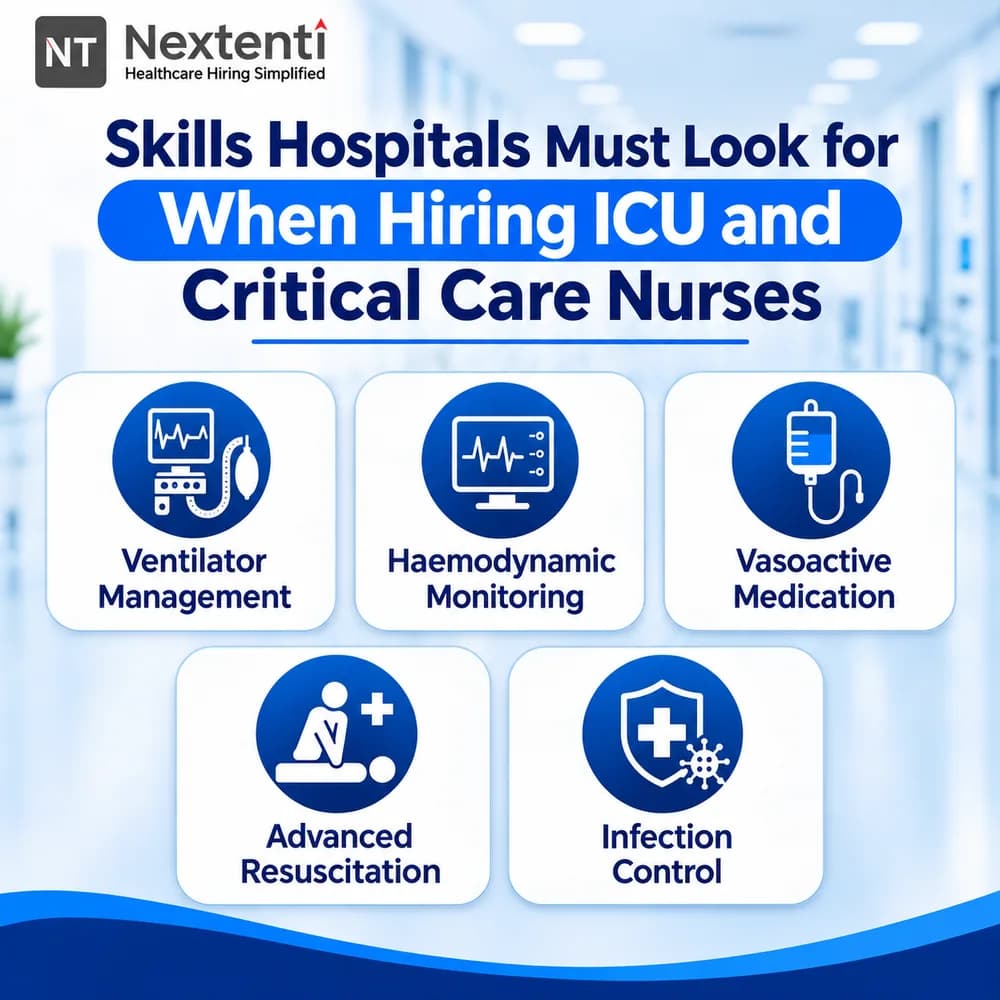
Critical care units demand advanced clinical judgement, rapid decision-making and specialised technical skills. For MICU, SICU and CCU roles, selection panels should assess five core competencies:
- Ventilator and airway management. Hands-on use of invasive and non-invasive ventilators, ventilation modes (AC, SIMV, PSV, PEEP), endotracheal suctioning, arterial blood gas interpretation and acute airway emergencies.
- Haemodynamic monitoring. Setting up and zeroing CVP and arterial lines, using multipara monitors and recognising cardiac dysrhythmias.
- Vasoactive medication administration. Accurate calculation, titration and administration of inotropes, vasopressors, sedatives and anti-arrhythmics through infusion pumps.
- Advanced resuscitation. Valid BLS and ACLS certification from a recognised body such as the American Heart Association or the Indian Resuscitation Council.
- Infection control. Adherence to CLABSI and VAP prevention bundles, hand hygiene protocols, and NABH infection control standards.
How Do Nursing Requirements Differ Across Hospital Departments?
Staffing needs vary by unit, so compare each vacancy against the nurse-to-patient ratios in the NABH and IPHS norms before you write the job description.
| Department | Recommended ratio | Experience | Main responsibilities |
|---|---|---|---|
| ICU | 1:1 ventilated; 1:2 non-ventilated | 2–5+ years in critical care | Continuous monitoring, invasive line care, resuscitation response, family updates |
| High Dependency Unit | 1:2 (IPHS); 1:3 (NABH advisory) | 1–3 years | Step-down care, oxygen therapy, early warning scoring, post-ICU recovery |
| Emergency Department | 1:1 ventilated; 1:4 non-ventilated | 2–4 years in emergency or trauma | Triage, Code Blue response, rapid IV access, acute stabilisation |
| Operation Theatre | 2 nurses per active table per shift | 2–5 years in OT | Scrub and circulating duties, instrument counts, sterile field |
| NICU / PICU | 1:2 per shift | 2–4 years in neonatal or paediatric care | Neonatal resuscitation, thermoregulation, gavage feeding, micro-dosing |
| Maternity / Labour Room | 1:1 per delivery bed | 1–3 years in midwifery | Partograph and fetal heart monitoring, newborn care, obstetric emergencies |
| General Medical / Surgical Ward | 1:6 per shift | 0–2 years (freshers accepted) | Medication rounds, documentation, wound dressing, discharge planning |
Write the department ratio into the workforce plan before you advertise. A vacancy count without a ratio understates the real need.
What Is the Best Nursing Recruitment Process for Hospitals in India?
The most effective hospitals treat nursing recruitment as a repeatable workflow rather than a reaction to each resignation.
Continue Your Journey
Not sure where to go next?
Whether you're searching for your next healthcare opportunity or hiring qualified professionals, Nextenti helps you connect with the right people through AI-powered matching.
👩⚕️ Looking for Jobs?
Browse verified healthcare opportunities across hospitals, clinics and healthcare organizations.
Browse Jobs →🏥 Hiring Talent?
Post jobs and receive AI-matched healthcare professionals faster.
For more on using hiring data, read our guide to workforce analytics for healthcare hiring. A structured process has ten stages:
- Workforce planning. Set headcount by unit using department ratios.
- Job description. Define the role, qualification, registration and shift pattern.
- Candidate discovery. Search verified databases and partner colleges.
- Job posting. Publish the vacancy on healthcare-specific channels.
- Applicant matching. Rank candidates against the role requirements.
- Screening. Filter on registration, specialty experience and notice period.
- Interviews and assessment. Combine panel interviews with clinical testing.
- Credential verification. Complete SNC and NRTS checks.
- Selection. Issue the offer and confirm joining dates.
- Onboarding. Run induction and a shadow period before independent duty.
How Should Hospitals Create Nursing Job Descriptions and Advertise Vacancies?
A clear job description filters out underqualified applicants and sets expectations. Include the following in every nursing advertisement:
- Specialty-specific title. Use “Staff Nurse – Surgical ICU” rather than a generic title.
- Educational requirement. State “B.Sc. Nursing or GNM Diploma from an INC-approved institution.”
- Registration clause. State that active State Nursing Council registration or a valid NUID is mandatory before joining.
- Experience. Define tenure in the relevant setting, for example two years of continuous ICU experience in a 100+ bed hospital.
- Shift expectations. Disclose the three-shift rotation, night shift frequency and weekly off policy.
- Compensation and benefits. Give the salary range, night allowances, food subsidy and PF and ESI benefits, together with the work location and employment terms.
Advertise on healthcare-specific platforms, because broad commercial portals produce less relevant applicants.
Where Can Hospitals Find Qualified and Experienced Nurses?
A strong channel mix combines several sources, each suited to a different type of vacancy.
- Specialised healthcare platforms. Platforms such as Nextenti provide a verified talent pool across 19 healthcare sectors and connect hospitals directly with qualified nursing candidates.
- Nursing college partnerships. Campus hiring from INC-approved colleges builds a pipeline for entry-level ward positions, and alumni networks extend that reach to experienced nurses.
- Employee referrals and associations. Referral bonuses paid after the new hire completes 90 days encourage staff to recommend colleagues, and professional nursing associations can circulate senior vacancies.
- Recruitment agencies. Agencies suit urgent or senior searches, although commissions raise the cost per hire.
How Can Hospitals Screen and Match Nursing Candidates Effectively?
A multi-stage screen improves efficiency and reduces costly mis-hires.
- Pre-screening. Check valid SNC registration, specialty experience, shift flexibility, a notice period under 30 days and salary expectations.
- Clinical knowledge test. Cover pharmacology calculations, IV drip rates, ECG reading, emergency protocols and infection control.
- Structured panel interview. Include an HR recruiter and the Chief Nursing Officer or Nursing Superintendent to assess technical competence, empathy and communication.
- Practical assessment (OSCE). For critical care roles, test ventilator setup, suctioning and sterile technique in a simulation lab or ward.
How Can Hospitals Track Nursing Applications and Shortlist Candidates Faster?
Managing applications through emails and spreadsheets causes delays and candidate drop-out. An applicant tracking system (ATS) gives every candidate a visible stage: Applied, Pre-Screened, Clinical Exam Passed, Interview Completed, Credential Verified, Offer Extended, and Onboarded.
Automated SMS or WhatsApp messages keep candidates engaged during notice periods and reduce interview no-shows.
Centralised records also let recruiters and nursing leaders collaborate on the same shortlist and schedule interviews without duplicate calls.
How Can Nextenti Simplify Nursing Recruitment for Hospitals?
Nextenti is India’s AI-powered healthcare hiring platform. The platform connects hospitals, clinics, and diagnostic centres with verified medical and non-medical professionals across 19 healthcare sectors.
This brings candidate discovery, job posting, matching, screening and application tracking into one organised workflow.
How Does Nextenti Help Hospitals Discover and Match Qualified Nurses?
Nextenti gives hospitals access to a verified database that includes nurses, doctors, technicians and non-clinical staff.
Nextenti’s matching engine compares a job requisition with candidate profiles using educational qualification (B.Sc. versus GNM), specialty experience such as ICU, OT or dialysis, location preference and availability.
The platform produces candidate Match Scores, so HR teams can identify suitable applicants without spending days sorting résumés manually.
How Can Hospitals Manage Job Postings, Screening and Applications Through Nextenti?
Nextenti centralises the hiring workflow in one dashboard:
- Simplified job creation. Hiring managers post detailed vacancies that specify specialty requirements, shift structure and clinical qualifications.
- Verified candidate profiles. Profiles undergo quality checks, so hospitals evaluate structured credentials rather than unverified claims.
- Structured résumés. Raw profile information is formatted into standard candidate résumés, which simplifies skill comparison.
- Real-time pipeline dashboard. HR teams monitor application status, schedule interviews and manage the pipeline on the web and on the mobile app for iOS and Android.
How Can Hospitals Reduce Nursing Recruitment Costs and Improve Retention?
Recruitment cost is more than an agency invoice. It includes advertising, recruiter time, verification, induction and the revenue lost when beds stay unstaffed.
Retention lowers all of these costs, because replacing a trained nurse costs approximately two to three times the nurse’s monthly salary, excluding lost revenue.
What Factors Influence the Cost of Recruiting Nurses in India?
Total cost per hire is the sum of six categories: agency commission, advertising, background verification, internal HR time, induction and the opportunity cost of vacancy.
Salary benchmarking is the other major driver, and it should separate government and private pay. The table below uses nurse salary benchmarks for 2026.
| Position | Experience | Private, Tier-1 metro (in-hand) | Private, Tier-2/3 (in-hand) | Government gross (7th CPC) |
|---|---|---|---|---|
| Staff Nurse (GNM) | 0–2 years | ₹15,000–₹20,000 | ₹10,000–₹15,000 | ₹55,000–₹68,000 |
| Staff Nurse (B.Sc.) | 0–2 years | ₹18,000–₹25,000 | ₹14,000–₹18,000 | ₹65,000–₹78,000 |
| ICU / Critical Care Nurse | 2–5 years | ₹25,000–₹42,000 | ₹18,000–₹28,000 | ₹75,000–₹85,000 |
| Senior Staff Nurse / Duty In-Charge | 5–8 years | ₹35,000–₹55,000 | ₹25,000–₹38,000 | ₹85,000–₹1,05,000 |
| Nursing Supervisor / Shift In-Charge | 5–10 years | ₹40,000–₹65,000 | ₹30,000–₹45,000 | ₹95,000–₹1,15,000 |
| Nursing Superintendent / CNO | 10+ years | ₹70,000–₹1,45,000+ | ₹45,000–₹85,000 | ₹1,10,000–₹1,42,400+ |
How Can Hospitals Retain Nurses After Recruitment?
Retention requires structural changes, not one-off bonuses. Four interventions matter most:
- Market-competitive compensation. Offer structured base pay, transparent night allowances, performance incentives and health insurance that covers nurses and their dependents.
- Workload protection and safe ratios. Running wards at 1:15 or 1:20 drives turnover. Keeping to NABH and IPHS standards of 1:6 in wards and 1:1 in ventilated ICU beds protects nurses from exhaustion, and well-planned shift rosters help further.
- Career advancement and sponsored CNE. Build a ladder from Staff Nurse to Senior Nurse, Clinical Specialist, Shift Supervisor and Nursing Superintendent, and sponsor the 30 CNE credits needed every five years.
- Mentorship and supportive leadership. Pair new hires with experienced preceptors for their first 90 days, and keep workplace safety and engagement initiatives visible.
How Can Hospitals Build a More Effective Nursing Recruitment Strategy?
An effective strategy rests on four practices that work together.
- Enforce credential compliance. Standardise primary source verification through the INC NRTS portal and State Nursing Council registers before deployment.
- Align workloads with NABH and IPHS ratios. Manageable rosters lower burnout and annual turnover.
- Build career pathways. Pair competitive pay with clinical ladders and preceptor mentorship.
- Use specialised recruitment technology. Move from generic job boards to a healthcare platform that organises discovery, matching, screening, job posting and tracking.
Nextenti supports the last of these. It helps hospitals discover and match nurses, publish vacancies faster, screen applicants, and follow every application in one dashboard.
Featured Jobs
Explore latest openings by profession or location
Jobs by Profession
Browse roles by specialty
Jobs by Location
Explore openings by city
Featured Jobs
Explore latest openings by profession or location
Jobs by Profession
Browse roles by specialty
Jobs by Location
Explore openings by city
Keep Reading
You Might Also Like
 Healthcare Jobs
Nursing Jobs in India: Roles, Eligibility, and Opportunities for Nurses
Explore nursing careers in India, including job opportunities, qualifications, eligibility, salaries, specialisations and overseas nursing jobs.

Meghana Ballekari
12 Nov 2026
 Career Guides
Doctor Jobs in India: How to Find the Right Opportunity
Find doctor jobs in India across hospitals and government institutions. Explore roles, salary ranges, medical specialities and application tips.
Sanjay Kagitha
10 Nov 2026
 Healthcare Hiring
How to Hire Qualified Doctors in India: A Guide for Hospitals and Healthcare Organisations
Learn how hospitals in India can hire qualified doctors. Explore recruitment channels, credential verification, hiring steps, costs and AI-powered hiring.
Sumitha Kini
10 Nov 2026