Nursing Jobs in India: Roles, Eligibility, and Opportunities for Nurses

Meghana Ballekari
12 Nov 2026 · 16 min read
The Ministry of Health and Family Welfare reports 39.40 lakh registered nursing personnel, yet the National Health Workforce Accounts put active nurse and midwife density at about 17.7 per 10,000 population.
That sits well below the WHO benchmark of 44.5 skilled health workers per 10,000 people.
For nurses, demand is real while vacancies are scattered. For employers, qualified candidates are hard to find and harder to verify.
This guide covers the main nursing jobs in India, the qualifications and registration each one needs, where to find government and private vacancies, what nurses earn, and how to grow a career at home or abroad.
What Are the Different Types of Nursing Jobs Available in India?
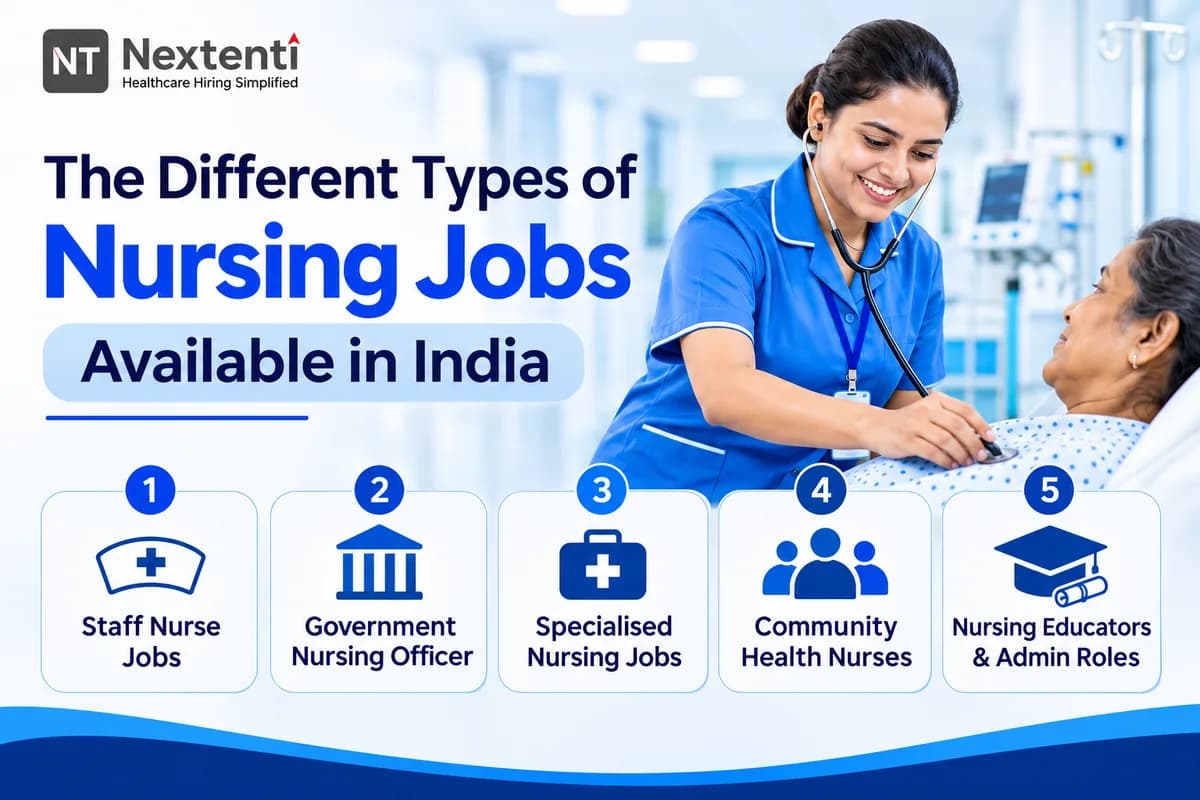
Nursing in India is several career tracks, split by clinical focus, setting, administrative duty and academic involvement.
Your qualification and registration decide which track you can enter, so know the tiers first.
Looking for your next nursing job? Nextenti is a healthcare recruitment platform that matches verified nurses to relevant vacancies. Create a profile, or talk to the Nextenti team if you are hiring.
Staff Nurse Jobs in Government and Private Hospitals
Staff nurses are the bedside workforce of wards, clinics and surgical centres. They monitor patients, give oral and intravenous medicines, manage IV lines, enforce infection control and keep documentation accurate.
Shifts rotate through mornings (07:00–15:00), evenings (15:00–23:00) and nights (23:00–07:00), or run as 12-hour blocks. Entry needs a GNM diploma or BSc Nursing plus RN and RM registration.
Private entry pay is ₹15,000 to ₹25,000 a month; permanent government posts follow pay matrices that start higher. Government posts suit nurses who want stability; private roles suit those who want faster entry.
Government Nursing Officer Jobs
Nursing Officers hold Group ‘B’ non-gazetted posts at central institutions such as AIIMS, ESIC hospitals, JIPMER and Railway medical centres.
They run high-dependency units, oversee ward workflows, enforce patient safety, mentor junior staff and handle complex medical technology. Recruitment is competitive, mainly through AIIMS’s NORCET and UPSC exams for ESIC.
Under the 7th CPC these posts sit at Pay Level 7, with a starting basic pay of ₹44,900 a month plus allowances.
Specialised Nursing Jobs in India
Specialist roles reward domain-specific skill, usually a post-basic diploma. Typical options include:
- ICU nurse: ventilator management and continuous infusions; one to two years of ICU experience and a critical care diploma
- Operation theatre nurse: scrub and circulating duties; an operation room nursing diploma
- Emergency and trauma nurse: triage and resuscitation; an emergency and disaster nursing diploma
- Paediatric, neonatal, oncology and dialysis nurses: PICU, NICU, chemotherapy and haemodialysis care, each with its own qualification
Specialist training is the quickest route to higher pay.
Community Health Nurses and Auxiliary Nurse Midwives
ANMs are frontline staff at Ayushman Arogya Mandirs and Primary Health Centres. They provide antenatal and postnatal care, deliver childhood immunisation, counsel on family planning and keep health registries.
Community Health Officers, usually BSc or Post Basic BSc graduates with the Certificate Programme in Community Health, run rural health posts under the National Health Mission. Jobs are permanent state posts or contractual NHM roles through State Health Societies.
Nursing Educators and Administrative Positions
Clinical and nursing tutors teach in classrooms and skill labs, needing a BSc Nursing with experience or an MSc Nursing.
Professors and Principals need an MSc in a recognised specialty and teaching experience; INC norms require a 1:10 teacher-student ratio.
In hospitals, supervisors and assistant nursing superintendents manage rosters and bed allocation, while nursing superintendents and Chief Nursing Officers lead facility-wide administration.
What Qualifications and Eligibility Criteria Are Required for Nursing Jobs in India?
Eligibility is a stack of four things: a recognised qualification, statutory registration, the experience a notification asks for, and the documents to prove it. Miss one layer and the application fails.
ANM and GNM Nursing Qualifications
ANM is a two-year diploma needing 10+2 with at least 40% aggregate, for ages 17 to 35, and leads to sub-centre and NHM health worker posts.
GNM runs 3.5 years (three years of study plus a six-month internship) and needs 10+2 with 40% to 45% aggregate. Graduates register as RANM or RN and RM.
GNM holders can take private staff nurse jobs at once, while central posts ask for experience.
BSc Nursing and Post Basic BSc Nursing
BSc Nursing is a four-year degree needing 10+2 with Physics, Chemistry, Biology and English and 45% aggregate (40% for SC/ST). Graduates move straight into staff nurse or Nursing Officer roles, with no post-qualification experience needed for entry-level central exams.
Post Basic BSc Nursing is a two-year upgrade for registered GNM holders, opening central Nursing Officer posts, CHO vacancies and MSc programmes.
Indian Nursing Council Recognition and State Nursing Council Registration
Your qualification counts only if it comes from a recognised institution. After an approved ANM, GNM or BSc course, you register with your State Nursing Council, such as Tamil Nadu, Maharashtra or Delhi, to receive RN and RM status.
Practising without active registration is prohibited under Section 23 of the NNMC Act. Keep renewal slips, and transfer your registration when you move states.
What Is Changing Under the NNMC Act?
The NNMC Act, 2023 replaces the Indian Nursing Council Act of 1947, adding a national commission, three boards and a live Indian Nurses and Midwives’ Register. The INC still maintains performance standards during the transition.
Work Experience, Age Limits, and Additional Eligibility Requirements
Rules vary by notification. For NORCET, BSc and Post Basic BSc holders need no experience, while GNM holders need two years in a hospital with at least 50 beds. The standard age band for central Nursing Officer posts is 18 to 30, with relaxations:
- SC/ST: 5 years; OBC (non-creamy layer): 3 years
- Persons with benchmark disabilities: 10 years (UR), 13 (OBC), 15 (SC/ST)
- Central government employees: up to 5 years (UR), 8 (OBC), 10 (SC/ST)
Serving government and PSU employees must also submit a No Objection Certificate at verification.
Where Can Nurses Find Government and Private Nursing Job Opportunities in India?
Nursing jobs come through five main channels: central institutes, state recruitment boards, contractual health missions, corporate hospital chains, and digital platforms.
Match your qualification to the channel instead of applying everywhere.
AIIMS Nursing Jobs and NORCET Recruitment
AIIMS runs NORCET twice a year, typically in April and September, for Group ‘B’ Nursing Officer posts. Stage I is a 90-minute computer-based test of 100 MCQs; Stage II is a 180-minute test of 160 case-based questions that decides merit.
Both carry negative marking of one-third mark. The application fee is ₹3,000 for General and OBC candidates and ₹2,400 for SC, ST and EWS, with PwBD applicants exempt. Under a 2019 decision, 80% of vacancies go to female candidates.
ESIC, JIPMER, and Railway Nursing Recruitment
ESIC recruits Level 7 Nursing Officers for its hospital network; one UPSC notification covered 1,930 Nursing Officer posts, with a ₹25 fee for general applicants. JIPMER runs its own computer-based exams at the same pay level.
Railway Recruitment Boards hire Nursing Superintendents and staff nurses through one- or two-stage tests, document verification and a medical fitness check, with a ₹500 fee for general candidates.
State Government Hospitals and National Health Mission Vacancies
State bodies such as the Tamil Nadu Medical Services Recruitment Board, UPPSC and the West Bengal Health Recruitment Board run drives for permanent posts in medical colleges and district hospitals.
The National Health Mission separately hires contractual staff nurses, CHOs and ANMs through District Health Societies, paying consolidated monthly stipends that each state sets. NHM posts are a structured way into public health.
Private Hospitals, Healthcare Groups, and Nursing Recruitment Platforms
Private recruitment is led by Apollo Hospitals, Fortis Healthcare, Manipal Hospitals, Max Healthcare, Narayana Health and Aster DM Healthcare. They hire through career portals, walk-in interviews, campus drives and agencies.
Traditional hiring leans on branch-level applications and unverified paper resumes, which slows screening. Platforms such as Nextenti list verified vacancies and capture structured credentials to ease that.
Ready to stop searching in ten places? Create your Nextenti profile and get matched to roles that fit your qualifications.
How Much Do Nurses Earn in India? Salary by Qualification, Experience, and Specialisation
Pay depends on sector, pay level, city, bed capacity and specialisation. Figures below are monthly and indicative: government numbers come from the 7th CPC matrix, while private ranges move with hospital category and negotiation.
Government Staff Nurse and Nursing Officer Salary
Central Nursing Officers at Pay Level 7 start at ₹44,900 basic, with Dearness Allowance of roughly 50% (about ₹22,450), HRA of 27%, 18% or 9% by city class, transport allowance and a nursing allowance. Typical entry figures:
- Gross monthly salary: ₹76,791 to ₹91,173
- Net take-home after NPS and tax: ₹68,000 to ₹81,000
- Basic pay by year: ₹44,900, ₹46,300, ₹47,700, ₹49,100, ₹50,600
Government pay is fixed and predictable, which is why these posts draw so many applicants.
Private Hospital Nurse Salary in India
Private pay starts lower but is more flexible. Entry-level nurses in metropolitan tertiary hospitals earn ₹15,000 to ₹25,000 a month (₹1.8 lakh to ₹3.0 lakh a year), while tier-2 and tier-3 nursing homes pay ₹12,000 to ₹18,000.
Continue Your Journey
Not sure where to go next?
Whether you're searching for your next healthcare opportunity or hiring qualified professionals, Nextenti helps you connect with the right people through AI-powered matching.
👩⚕️ Looking for Jobs?
Browse verified healthcare opportunities across hospitals, clinics and healthcare organizations.
Browse Jobs →🏥 Hiring Talent?
Post jobs and receive AI-matched healthcare professionals faster.
With three to five years of bedside experience, that rises to ₹25,000 to ₹40,000. Night allowances (₹150 to ₹400 a night), overtime and subsidised accommodation or transport may be added. Metropolitan hospitals pay more on paper, so weigh offers against local living costs.
How Nursing Specialisations and Experience Affect Salary
Experienced ICU, OT and emergency nurses earn 15% to 30% more base pay than ward nurses in corporate networks, averaging ₹35,000 to ₹55,000 a month. Administrative growth pays more again:
- Nursing supervisor or shift in-charge (5+ years): ₹35,000 to ₹60,000
- Assistant Nursing Superintendent (8+ years): ₹50,000 to ₹85,000
- Nursing Superintendent or CNO (12+ years): ₹75,000 to ₹1,80,000+, depending on facility size
Specialist skills raise both pay and employability, because private hospitals are actively recruiting for these units.
What Challenges Do Nurses Face When Searching for the Right Job in India?
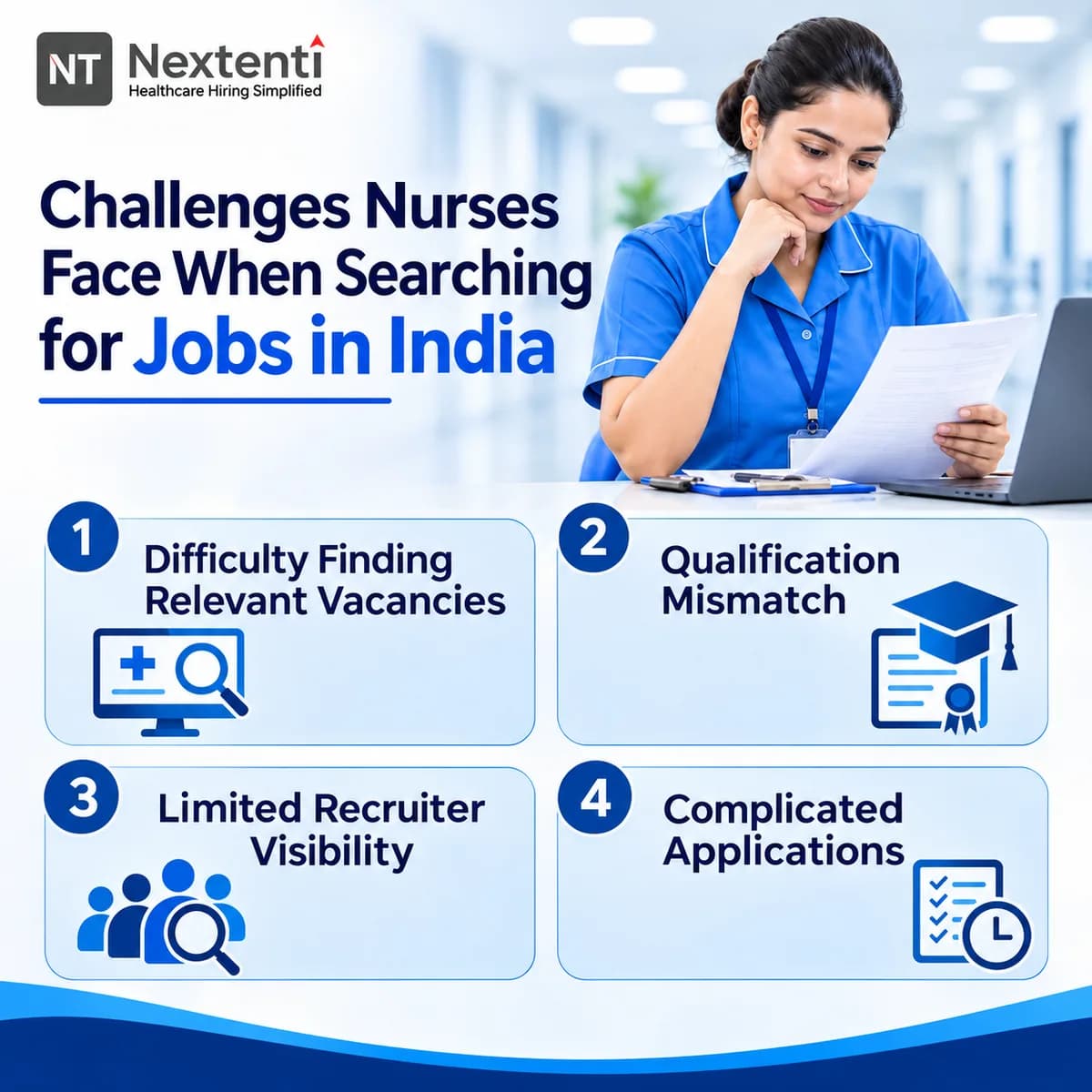
Demand is high, yet job hunting is slow - currently, the global average nurse density is 37, and India sits above that mark.
The issue however, is that nurses face scattered vacancies, unclear eligibility, repeated paperwork and silence after applying.
Paired with this, employers see too many unsuitable applications and too few verifiable specialists.
Difficulty Finding Relevant Nursing Job Vacancies
Openings are spread across government portals, hospital career pages, regional classifieds and general job boards, so tracking what is live takes effort.
General portals often show expired nursing vacancies, which means applications sent for jobs that have already closed.
Vague descriptions and location limits make a genuine opening hard to tell from noise, and every wasted application costs time and fees.
Mismatch Between Nursing Qualifications and Employer Requirements
Listings often fail to say whether a GNM diploma is accepted or a BSc Nursing degree is required, and rejections follow. NORCET adds a hard rule: GNM applicants need two years of experience in a hospital with at least 50 beds.
Many nurses then find their experience certificates never state bed capacity, and verification ends the application.
Limited Visibility Among Hospital Recruiters
Applicant tracking systems often struggle to parse clinical resumes, so a qualified specialist nurse can be overlooked.
Hospital HR teams, meanwhile, are limited to local networks because few verified national profiles exist. Nurses with exactly the right ICU or OT experience and hospitals with exactly the right vacancy never meet.
Complicated Applications and Lack of Recruitment Updates
Nurses re-enter qualifications and re-upload certificates on every portal, then wait without status updates on shortlisting or interviews.
That uncertainty is costly when you are deciding whether to resign, relocate or accept an offer. Thin communication makes the hiring journey feel opaque on both sides.
How Does Nextenti Help Nurses Discover and Secure Relevant Job Opportunities?
Nextenti is a digital healthcare recruitment platform that connects verified nursing professionals with healthcare institutions.
It targets the friction points above: discovery, matching, screening, posting and tracking, with credentials held in one structured profile.
Candidate Discovery: Helping Employers Find Qualified Nurses
Nurses build a structured profile with qualifications (ANM, GNM, BSc, Post Basic, MSc), State Nursing Council registration numbers, clinical specialisations, shift availability and documented bed-count experience.
Recruiters filter by those parameters instead of searching unstructured resumes, so a hospital looking for a dialysis nurse finds dialysis nurses.
Job Matching: Connecting Nurses With Suitable Opportunities
Matching algorithms align profiles with verified hospital openings, weighing experience thresholds, bed-count rules, location preferences and clinical sub-specialties.
Relevant postings surface first, which reduces unsuitable applications and spares nurses from applying for roles whose eligibility rules they cannot meet.
Candidate Screening: Making Nursing Recruitment More Efficient
Screening tools let HR teams check credentials, active state registrations and clinical experience before interviews are scheduled, cutting manual resume sorting for clinical administrators.
Verified profiles shorten the checking stage, but hospitals should still confirm registrations and certificates under their own policy.
Job Posting: Helping Healthcare Employers Reach Relevant Candidates
Hospitals publish detailed descriptions covering qualification requirements, unit assignments, shift schedules and compensation.
Clear postings widen vacancy visibility across regions and attract candidates who already meet the stated criteria, which lowers drop-out during verification.
Application Tracking: Improving Visibility Throughout Recruitment
Candidates can follow an application through screening, shortlisting, interview scheduling and the final decision, while recruiting teams manage the pipeline in one place. Visible status replaces the silence that frustrates nurses, and fewer follow-up queries reach HR.
How Nurses and Healthcare Employers Benefit From Nextenti
Each friction point has a matching capability:
- Fragmented vacancies: one portal of verified openings for nurses, and an active pool of job seekers for employers
- Qualification and bed-count mismatch: clearer alignment for nurses, fewer disqualifications at verification for employers
- Opaque hiring status: real-time progress for candidates, fewer HR follow-ups
- Manual screening delays: structured credentials for recruiters, faster shortlisting
How Can Nurses Improve Their Chances of Getting Hired in India?
A strong nursing application is mostly paperwork done right. Employers read registration, qualifications, and experience first, so shortlisted nurses are usually those whose documents answer eligibility questions before anyone asks.
Build a Professional Nursing Resume and Candidate Profile
Put your State Nursing Council registration number, RN and RM validity, and degrees at the top. Then list clinical rotations, units managed (for example, a 20-bed Medical ICU), the bed count of each employer, and equipment handled, such as ventilators and dialysis machines.
Add BLS, ACLS and PALS certification, infection control training and post-basic diplomas.
Apply for Jobs That Match Your Qualifications and Experience
Read each notification for the qualification it accepts, the experience it demands, and the location, specialisation and salary on offer.
If a role asks for post-qualification experience, as NORCET does for GNM holders, confirm your certificates state hospital bed capacity before paying a fee. Applying selectively beats applying widely.
Prepare for Nursing Interviews and Recruitment Examinations
Revise anatomy, physiology, pharmacology, medical-surgical nursing, maternal-child health and infection control, and be ready to discuss patient safety and emergency response.
For NORCET and state exams, practise clinical-scenario MCQs and past computer-based papers to build speed under negative marking.
Keep Professional Credentials and Nursing Registrations Updated
Keep a digital folder ready so verification never delays an offer:
- Proof of age and 10+2 mark sheets
- Nursing degree or diploma certificates and mark sheets
- State Nursing Council registration (RN and RM) and renewal slips
- Experience certificates stating dates, duties and hospital bed strength
- No Objection Certificate from a current government employer, if applicable
- Category certificate in the prescribed central format, if applicable
- Active BLS and ACLS cards
What Career Growth Opportunities Are Available for Nurses in India and Abroad?
Nursing offers long-term growth through advanced degrees, clinical specialisation, leadership and migration.
The right path depends on whether you want to stay at the bedside, teach, manage or work abroad, and each one starts with an upgrade in qualification or experience.
Advanced Nursing Education and Specialisation
MSc Nursing is a two-year postgraduate programme in medical-surgical, paediatric, obstetrics and gynaecology, psychiatric or community health nursing, leading to clinical specialist and faculty roles.
One-year post-basic diplomas and Nurse Practitioner programmes, such as critical care, prepare nurses for advanced practice, while a PhD in Nursing leads to research and professorships.
Career Progression Into Nursing Leadership and Administration
Progression follows experience, performance and postgraduate qualifications:
- Staff Nurse or Nursing Officer (years 0–3): bedside care and procedures
- Senior Staff Nurse or Charge Nurse (years 4–7): shift oversight and complex cases
- Nursing Supervisor or Assistant Nursing Superintendent (years 8–12): resources, quality and rostering
- Nursing Superintendent (years 12–15): hospital-wide nursing workflow and HR
- Chief Nursing Officer or Nursing Director (15+ years): governance, policy and budgets
International Nursing Job Opportunities for Indian Nurses
Indian-trained nurses remain in demand overseas. Every destination asks for a licensing exam, English proficiency and credential verification. Typical starting gross salaries:
- UK: NMC Test of Competence, IELTS 7.0 or OET Grade B, NHS sponsorship; £28,407 to £34,581 (Band 5)
- Australia: Outcome-Based Assessment, IELTS 7.0 or OET Grade B, AHPRA registration; AUD 68,000 to 82,000
- Canada: REx-PN or NCLEX-RN, NNAS assessment; CAD 62,000 to 78,000
- UAE and Gulf: DHA, DoH or MOH exams, DataFlow verification; AED 72,000 to 120,000, tax-free
- US: NCLEX-RN, CGFNS evaluation, EB-3 visa; $65,000 to $85,000
Plan your next move. See how Nextenti works for nurses and employers.
Featured Jobs
Explore latest openings by profession or location
Jobs by Profession
Browse roles by specialty
Jobs by Location
Explore openings by city
Featured Jobs
Explore latest openings by profession or location
Jobs by Profession
Browse roles by specialty
Jobs by Location
Explore openings by city
Keep Reading
You Might Also Like
 Healthcare Hiring
Nursing Recruitment in India: How Hospitals Can Find and Hire Qualified Nurses
Explore nurse recruitment in India, including nursing qualifications, hospital staffing requirements, hiring channels, recruitment costs and AI hiring solutions.

Srikanth
12 Nov 2026
 Career Guides
Doctor Jobs in India: How to Find the Right Opportunity
Find doctor jobs in India across hospitals and government institutions. Explore roles, salary ranges, medical specialities and application tips.
Sanjay Kagitha
10 Nov 2026
 Healthcare Hiring
How to Hire Qualified Doctors in India: A Guide for Hospitals and Healthcare Organisations
Learn how hospitals in India can hire qualified doctors. Explore recruitment channels, credential verification, hiring steps, costs and AI-powered hiring.
Sumitha Kini
10 Nov 2026