How to Hire Qualified Doctors in India: A Guide for Hospitals and Healthcare Organisations

Sumitha Kini
10 Nov 2026 · 14 min read

Hiring a doctor is not like filling any other vacancy. Every clinical decision in a hospital passes through a doctor first, so each appointment shapes patient outcomes, legal risk, accreditation and financial performance.
India does not have a shortage of doctors in aggregate. The JP Nadda, Union Health Minister, told the Rajya Sabha in December 2025 that the country has 13,88,185 registered allopathic doctors, which works out to about one doctor for every 811 people when 80% are assumed to be in active practice.
That is better than the WHO benchmark of 1:1,000. And also shows that doctors are not scarce - but finding the right talent can be.
This guide covers the types of doctors hospitals hire, how to verify credentials, and how AI-powered platforms such as Nextenti can shorten the hiring cycle.
What Types of Doctors Should Hospitals Hire in India?
Hospitals usually hire doctors across four tiers, depending on clinical complexity, bed capacity and the services offered. Identifying the right tier first prevents both over-hiring and under-hiring.
1. General Physicians and General Practitioners
These are MBBS-qualified doctors who handle primary healthcare, outpatient consultations, preliminary diagnosis, and preventive care.
In most hospitals, they are the first clinical line managing routine patients, ward rounds, and emergency triage as Medical Officers or Casualty Medical Officers.
2. Specialist Doctors
Specialists hold a postgraduate qualification: an MD for non-surgical and diagnostic fields, an MS for surgical fields, or a DNB awarded by the National Board of Examinations in Medical Sciences (NBEMS).
This tier includes paediatricians, radiologists, gynaecologists, dermatologists, orthopaedic specialists and physicians supporting cardiology and neurology services.
Demand is highest in the large disciplines, which is why hiring specialist doctors is usually the most time-consuming part of workforce planning. Postgraduate capacity is growing: PG seats rose from 31,185 in 2014 to 82,059 in 2025.
3. Super-Specialist Doctors
Holding a DM or MCh, these doctors work in cardiothoracic surgery, neurosurgery, oncology, and other tertiary care areas, performing complex procedures and specialised interventions.
While a few of these doctors are essential, the ones you hire depend on your specific hospital needs.
DM and MCh Holders are eligible to lead departments and handle complex tertiary care procedures.
Because they are scarce and command the highest pay, many hospitals engage interventional cardiologists and similar super-specialists as visiting consultants rather than full-time employees.
4. Resident Doctors and Medical Consultants
Junior residents and Resident Medical Officers (RMOs) provide round-the-clock ward cover, while senior residents form the operational backbone of busy departments.
DNB holders often bring hands-on experience from high-volume corporate hospitals, which is a recruitment advantage.
Above them, full-time consultants work on fixed salaries, whereas visiting consultants are engaged on revenue-sharing or fee-for-service terms.
How to Verify a Doctor's Qualifications and Medical Registration in India
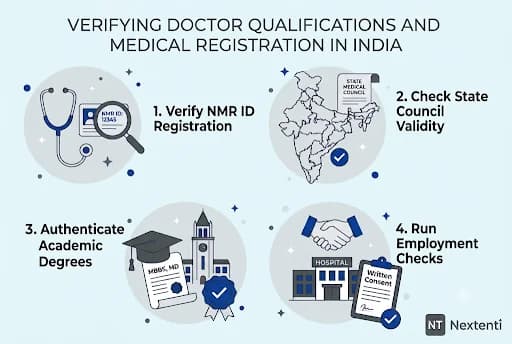
Credential verification is the least visible part of hiring and the most expensive to skip. Employing a doctor with a lapsed, suspended or fraudulent registration exposes the hospital to civil and criminal liability and can put accreditation at risk. Verification is a legal safeguard, not a formality. Complete the six checks below before the joining date.
1. Verify Registration Through the National Medical Register
The National Medical Commission maintains the National Medical Register, a searchable digital database of registered practitioners, and every doctor gets a unique NMR ID.
Two cautions apply. First, NMR enrolment is still in progress: about 1.66 lakh doctors had enrolled by October 2026, and the unified portal linking all State registers was still being commissioned.
A doctor's absence from the online register does not prove that the doctor is unregistered; resolve it with the State Medical Council.
Second, an NMC draft amendment published in August 2026 proposes to show each doctor's licence status (active or inactive) and any disciplinary action on the NMR. It is still a draft and has not been notified, but this has the potential to help doctor recruitment significantly.
2. Check State Medical Council Registration
State Medical Councils process applications and issue the licence to practise, and the national register draws on their records.
Ask for the registration certificate and confirm the registration number, issuing council, date of registration, and current validity. Also ask the council about any disciplinary history.
The 2023 regulations provide that a licence is valid for five years and must be renewed through the State Medical Council; if renewal is not sought in time, the entry becomes inactive, and the doctor may not practise.
When a doctor moves between states, the registration number stays the same and only the state code changes, so ask for proof that the transfer application has been filed and approved.
3. Authenticate Medical Degrees and Specialisations
Forged certificates are a real risk, so verify at the source. Ask the issuing university to confirm MBBS, MD, MS, DM and MCh degrees, and use NBEMS verification for DNB, DrNB and FNB certificates. Confirm that each qualification is recognised by the NMC and that the one-year compulsory rotating internship was completed. Inspect the original marksheets and the internship certificate yourself.
4. Check Foreign-Trained Doctors Separately
Foreign medical graduates must clear the Foreign Medical Graduate Examination (FMGE), complete the mandatory internship in India, and obtain registration.
The National Exit Test (NExT) is intended to replace the FMGE but has not been implemented, and an NMC draft published in August 2026 keeps the FMGE for provisional NMR registration until NExT comes into force.
Ask for the FMGE pass certificate, the internship completion certificate and the registration certificate.
5. Conduct Background and Employment Verification
Confirm previous employers, designations, tenure, and reasons for leaving. Speak to former Heads of Department about clinical skills and conduct.
Obtain written candidate consent before running checks and store the records securely.
India's Digital Personal Data Protection Rules were notified on 14 November 2025, and most obligations, including notice and security safeguards, take effect 18 months later.
6. Complete Clinical Credentialing and Privileging
Verification confirms who the doctor is. Privileging defines what the doctor may do.
NABH's 6th edition standard on credentialing and privileging (HRM.11) expects hospitals to:
- Identify medical professionals qualified for unsupervised patient care, document and update their education, registration, training and experience, and verify credentials, including against the NMC website.
Privileges are then granted on the basis of qualification, experience, training and registration, and reviewed annually. New faculty are proctored until independent privileges are granted.
In practice, a credentialing and privileging committee reviews the verified file and approves a written scope, such as OPD consultation, admission rights, and specific procedures, before the doctor works independently.
Where Can Hospitals Find and Recruit Qualified Doctors in India?
The most effective hospitals match each sourcing channel to the role.
An RMO and a senior neurosurgeon do not look for jobs in the same places, and hiring specialist doctors in particular requires channels that reach candidates who are not actively applying.
1. Medical Recruitment Agencies
Healthcare recruiters maintain doctor databases that include passive candidates who never browse job boards.
They handle sourcing, preliminary screening and placement, which suits senior consultants and Heads of Department. The trade-off is cost, covered in the cost section below.
2. Online Job Portals and Medical Job Boards
General platforms such as Naukri and LinkedIn offer wide reach at a lower cost and suit volume hiring of Medical Officers, duty doctors and junior residents. They also generate heavy application noise and manual screening.
Healthcare-specific platforms narrow the field. On Nextenti, a hospital posts a role and is matched with relevant healthcare professionals, while doctors browse Nextenti's doctor job listings.
3. Medical Associations and Professional Networks
Specialist societies, medical conferences and alumni networks put hospitals in front of experienced doctors who are not job hunting.
Referral programmes, in which existing consultants earn an incentive for bringing in peers, add trust. These channels are slower, so start early.
4. Medical Colleges and Teaching Hospitals
India now has 818 medical colleges, up from 387 in 2014, and MBBS seats have risen from 51,348 to 1,28,875. The pipeline of fresh MD, MS and DNB graduates and senior residents is larger than ever. Campus drives timed to residency completion give early access, though starting pay is lower and graduates need time to reach consultant level.
How to Hire Qualified Doctors in India: A Step-by-Step Recruitment Process
A defined workflow for doctor recruitment in India shortens vacancies and keeps the hospital compliant.
The eight steps below cover the full cycle from workforce planning to onboarding, with the owner and output for each step so that HR teams can assign responsibility and track progress.
As a planning assumption, allow two to six months from requisition to joining for specialist and super-specialist roles. The range depends mainly on notice periods, sourcing difficulty and verification time.
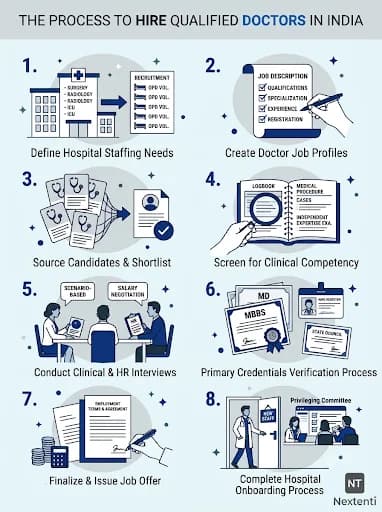
Step 1 - Define Staffing Requirements
Audit departmental vacancies, bed capacity, OPD and IPD volumes and shift coverage. Compare the numbers with statutory minimums and NABH staffing norms, then rank vacancies by clinical and revenue impact so that urgent roles are filled first.
Step 2 - Write Detailed Job Descriptions
State the qualifications, speciality, minimum experience, registration requirements, procedural skills, call-duty expectations, working hours and pay range. Be specific: “MD or DNB in Radiology with five years' post-qualification experience” is more useful than “Radiologist”. On Nextenti, the job post is the basis for AI candidate matching.
Step 3 - Source and Shortlist
Continue Your Journey
Not sure where to go next?
Whether you're searching for your next healthcare opportunity or hiring qualified professionals, Nextenti helps you connect with the right people through AI-powered matching.
👩⚕️ Looking for Jobs?
Browse verified healthcare opportunities across hospitals, clinics and healthcare organizations.
Browse Jobs →🏥 Hiring Talent?
Post jobs and receive AI-matched healthcare professionals faster.
Use agencies, job portals, referrals and databases together. Match every application against the mandatory criteria (registration, qualification, minimum experience) before any interview, so that the shortlist is clean. Platform-based matching and automated screening reduce manual CV review.
Step 4 - Screen for Clinical Experience and Competency
Review years of experience, previous hospital roles, procedure logbooks and patient volumes. Look for evidence of independent practice, such as the number of procedures performed unsupervised, not just claims on a CV.
Step 5 - Conduct Clinical and HR Interviews
Run a clinical panel led by the Head of Department, using scenario-based interview questions on clinical judgement, ethics and communication. Follow with an HR round covering behaviour, expectations, notice period, and salary. Use one scoring sheet across panels so that candidates can be compared fairly.
Step 6 - Complete Credential and Background Verification
Carry out the six checks described above. Start verification when a candidate reaches the final round, not after the offer, and make the offer conditional on clear results.
Step 7 - Finalise Terms and Issue the Offer
Set out the compensation structure, benefits, joining timeline, notice-period buyout (if any) and professional indemnity cover in a clear employment contract or consultant agreement. State that clinical privileges are subject to committee approval.
Step 8 - Complete Onboarding and Clinical Orientation
Cover hospital policies, clinical protocols, electronic health records, infection control and patient-safety procedures. Present the verified credentials to the credentialing and privileging committee for sign-off before the doctor practises independently.
How Much Does It Cost to Hire Doctors in India?
So, how much will this cost? Well, it depends on specialisation, experience, location, contract type, and the channels you use. The most overlooked cost isn’t the fee; it’s the empty position.
Factors That Influence Doctor Recruitment Costs
The direct cost to hire qualified doctors in India start with agency fees, which run 15% to 18% of annual CTC for senior consultants and department heads.
Keep in mind that a vacancy left open usually costs more in lost surgeries and diagnostics than the fees above, so budget for speed as well as price.
Beyond that, expect these to move your budget:
- Doctor seniority and medical specialisation
- Candidate scarcity in your city or speciality
- Relocation and housing support
- Sourcing channels, such as portals and agency retainers
- Joining bonuses and notice period buyouts
Salary Expectations Across Different Medical Specialisations
In terms of numbers, salary expectations can vary based on the type of hospital and the location, but these are the typical costs when hiring qualified doctors in India.
Pay varies widely by hospital type and city. MyInhand’s 2026 data puts private-sector duty doctors and RMOs at ₹5 to ₹10 LPA, and senior consultants at roughly ₹35 to ₹50 LPA.
Super-specialists such as interventional cardiologists and oncologists can cross ₹1 crore at the top end.
Government posts follow the 7th CPC pay scale, which means lower base pay but more stability. Location matters as well, since metro hospitals usually pay more than those in smaller cities, though some smaller hospitals close the gap with incentives.
Common Challenges Hospitals Face When Recruiting Qualified Doctors in India
Recruiting doctors is difficult for reasons that extend beyond any single hospital: specialist shortages, geographic imbalance, rising pay expectations, and long vacancies push timelines out and costs up.
Most of these problems are systemic, so hospitals do better by planning around them.
1. Shortage of Specialist and Super-Specialist Doctors
India's shortage is a specialist shortage. In public rural community health centres, the largest gaps in March 2023 were among surgeons (73% of sanctioned posts unfilled), physicians (69%), paediatricians (68%) and obstetricians and gynaecologists (61%).
The data covers public facilities, but it shows where supply is thinnest and why hospitals compete hard for the same limited pool.
Nextenti helps HR teams and hospitals with: candidate discovery and AI matching by speciality, qualification, experience, and availability, surfacing relevant specialists from a verified pool without manual searching.
2. Recruiting Doctors for Tier-2 and Tier-3 Cities
Specialists often hesitate to leave metros because of children’s schooling, spousal career options, and weaker diagnostic infrastructure.
Smaller-city hospitals bridge the gap with pay premiums, subsidised housing, relocation help and guaranteed procedure volumes.
For locum, part-time, and shift-based roles sit alongside permanent ones, Nextenti helps both candidates and hospitals.
This can be done through listings that make it easy for a smaller hospital to offer flexible arrangements to doctors who are not ready to relocate permanently.
3. High Recruitment Costs and Long Hiring Timelines
Hiring for senior and super-specialist roles commonly takes several months, and every empty month means idle beds and unperformed procedures.
Interview delays, notice periods, candidate dropouts, and agency fees add to the bill.
For HR teams and hospitals, simpler job posting and automated screening reduce manual CV review, and application tracking shows exactly where each vacancy is stuck.
4. Doctor Retention and Workforce Stability
Poaching by competing hospital groups, heavy duty hours, and workplace-safety concerns drive burnout and early resignations.
Career progression, professional development, fair rostering and a supportive culture keep physicians engaged over the long term. Hiring for fit, not only for qualifications, reduces early attrition.
Platforms like Nextenti help by matching on experience, availability, and preferred work format, helping hospitals shortlist candidates whose expectations fit the role.
How Medical Recruitment Agencies Help Hospitals Hire Qualified Doctors
For many hospitals, an agency is worthwhile when the role is hard to fill and time is short. Specialist recruiters source candidates, conduct preliminary screening, coordinate interviews, and support placement, so internal HR teams are not buried in CVs.
They add the most value when hiring specialist doctors in scarce disciplines.
1. Access to a Wider Network of Medical Professionals
Agencies maintain proprietary databases of active and passive medical talent, including experienced consultants who never visit public job portals.
That targeted access matters most for hard-to-fill vacancies where the talent pool is thin. Think of it as borrowing a recruiter’s address book.
2. Faster Doctor Sourcing and Candidate Shortlisting
By pre-screening candidates, confirming availability and checking salary expectations before presenting them, agencies cut your internal screening load.
Better candidate matching and vacancy management also reduce overall hiring timelines. In short, your HR team only meets candidates who already fit.
3. Medical Credential Screening and Verification Support
Established recruiters run preliminary checks on degrees, registration documents and work history, so your team receives a vetted candidate file.
However, this support doesn’t replace your own primary source verification, which still needs to happen.
4. Permanent, Contractual and Locum Doctor Recruitment
Agencies offer permanent placements, fixed-term contracts (say, for maternity cover), visiting consultants, and locum doctors who step in quickly when a vacancy suddenly opens.
That flexibility helps you keep 24/7 departmental coverage.
How AI-Powered Healthcare Recruitment Platforms Simplify Hiring
AI-powered recruitment platforms apply software to the repetitive parts of hiring: finding candidates, comparing them with the job requirements, screening applications, and tracking progress. They do not replace clinical judgement or primary-source verification.
With this in mind, the platform shortlist still needs a clinical interview, primary-source credential checks, and privileging by the hospital's own committee. Candidate data should be handled with consent and in line with India's data protection rules.
However, these types of platforms remove the manual work that delays those decisions, which makes them a practical option for doctor recruitment in India.
| Hiring task | Manual approach | With an AI-powered platform |
|---|---|---|
| Candidate discovery | Keyword searches, WhatsApp groups and referrals | One searchable pool of verified healthcare professionals |
| Matching | HR reads CVs against the job description | Matching on speciality, qualification, experience and availability |
| Screening | Manual review of every application | Automated screening against mandatory criteria such as qualification and experience |
| Job posting | Separate posts on several portals | One structured post that feeds matching and tracking |
| Application tracking | Spreadsheets and email threads | A single pipeline showing each candidate's stage and each vacancy's age |
Doctor Recruitment Checklist for Hospitals in India
Ready to put all of this into practice? The registration, degree, and privileging checks are compliance essentials, while reference calls and interview scoring are best practices that protect you from hiring regret.
Here’s a checklist you can print and hand to your HR team. If every box is ticked before the joining date, you’ve done the hard part.
- Confirm the staffing need, role profile and budget approval
- Write a detailed job description covering qualifications, minimum experience, procedural skills, registration and call-duty expectations
- Verify the MBBS degree is from an NMC-recognised university
- Check the one-year internship completion certificate
- Authenticate the MD, MS, DNB, DM or MCh qualification
- Validate the doctor’s ID on the National Medical Register
- Confirm active State Medical Council registration
- For foreign graduates, verify FMGE or NExT clearance and internship
- Review clinical experience and procedure logbooks
- Complete clinical and HR interview scoring, with notes from both panels
- Run background checks and references, with written consent
- Sign the contract and complete privileging and onboarding paperwork
How Nextenti Helps Hospitals Hire Qualified Doctors Across India
Each challenge in this guide comes down to the same questions: where to find the right doctors, how to shortlist them quickly and how to keep the process organised.
Nextenti is an AI-powered healthcare hiring platform that connects hospitals, clinics and medical organisations with verified healthcare professionals across 19 sectors. For hiring specialist doctors, it covers the whole workflow:
| Hiring Need | How Nextenti Helps |
|---|---|
| Candidate discovery | Source verified healthcare professionals across specialities from one platform |
| Matching | AI matching on specialisation, credentials, experience and availability, not just keywords |
| Screening | Automated screening against your job requirements, so HR reviews fewer, better-fitting applications |
| Job posting | Create and publish a role in one place, with the post driving candidate matching |
| Application tracking | Follow every applicant from application to offer in one view |
| Flexible cover | Permanent, locum, shift-based, part-time, freelance and remote roles in one place |
Nextenti profiles undergo verification, but hospitals should still complete the primary-source checks described above and privilege each doctor through their own committee.
Posting, screening, tracking and closing a role can happen in one platform, which reduces the number of tools and handoffs HR teams manage.
Ready to hire qualified doctors without the wait? Sign up to Nextenti and post your first vacancy today.
Featured Jobs
Explore latest openings by profession or location
Jobs by Profession
Browse roles by specialty
Jobs by Location
Explore openings by city
Featured Jobs
Explore latest openings by profession or location
Jobs by Profession
Browse roles by specialty
Jobs by Location
Explore openings by city
Keep Reading
You Might Also Like
 Healthcare Hiring
Nursing Recruitment in India: How Hospitals Can Find and Hire Qualified Nurses
Explore nurse recruitment in India, including nursing qualifications, hospital staffing requirements, hiring channels, recruitment costs and AI hiring solutions.

Srikanth
12 Nov 2026
 Healthcare Jobs
Nursing Jobs in India: Roles, Eligibility, and Opportunities for Nurses
Explore nursing careers in India, including job opportunities, qualifications, eligibility, salaries, specialisations and overseas nursing jobs.
Meghana Ballekari
12 Nov 2026
 Career Guides
Doctor Jobs in India: How to Find the Right Opportunity
Find doctor jobs in India across hospitals and government institutions. Explore roles, salary ranges, medical specialities and application tips.
Sanjay Kagitha
10 Nov 2026