Why Choose Nextenti? How It Compares with Other Healthcare Hiring Platforms

Meghana Ballekari
29 Oct 2026 · 10 min read
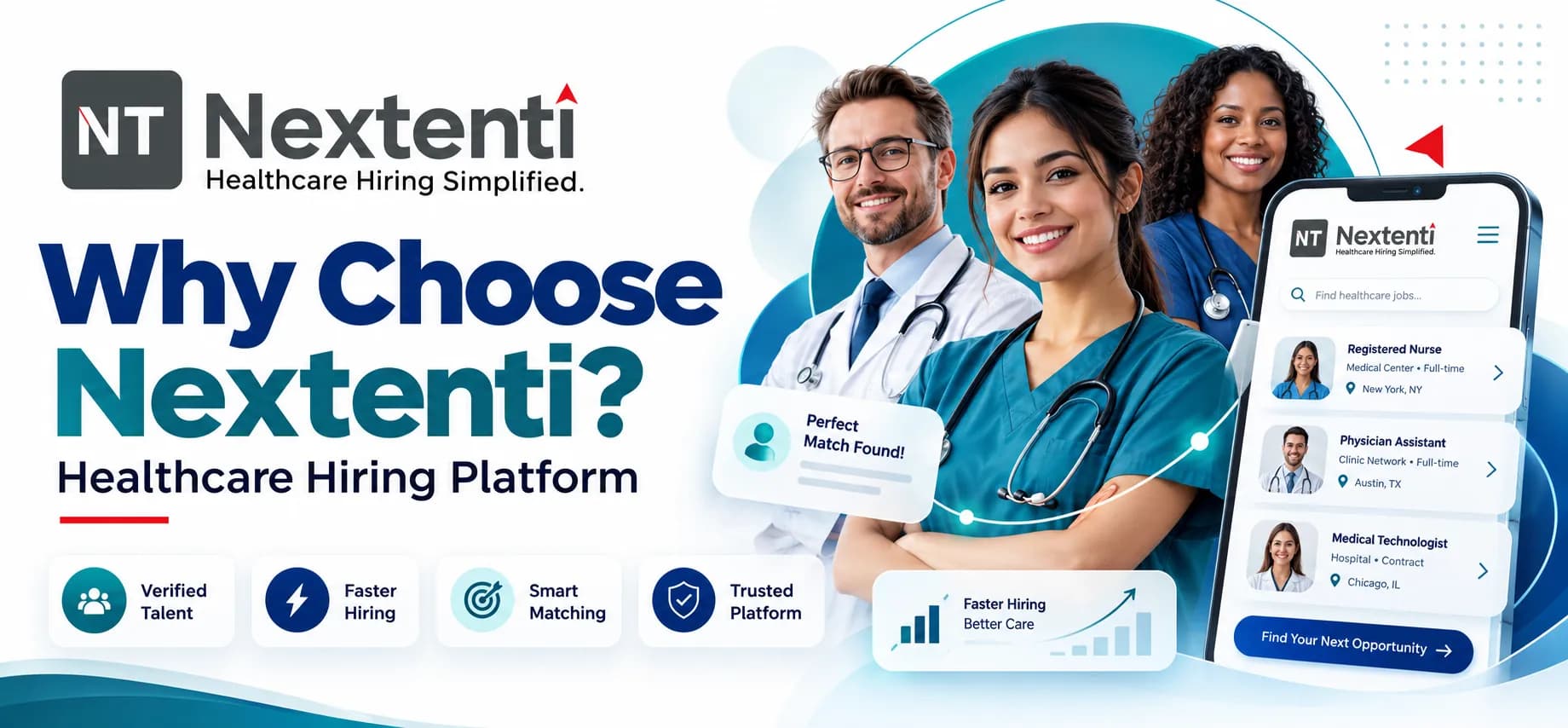
A healthcare-specific hiring platform matches verified professionals to the right roles, formats and locations, helping hospitals hire faster and more accurately.
Introduction: The Changing Healthcare Hiring Landscape
Healthcare hiring is changing faster than what most hospitals and clinics could keep up with. Despite demand for medical professionals rising, the healthcare hiring system still relies on walk-in interviews, word-of-mouth referrals, and general job portals that treat a surgeon's vacancy and a software developer's vacancy the same way.
For candidates, the experience is just as scattered. A nurse searching for medical jobs in Hyderabad or a lab technician searching for medical jobs in Bangalore often have to sift through hundreds or even thousands of irrelevant listings on generic job boards.
This gap has given rise to modern solutions: a specialized healthcare jobs platform. Unlike generic job portals or traditional healthcare hiring agencies, these platforms are specifically built for medical sectors. They understand credentials, specializations, shift patterns, and compliance requirements from day one.
What is Nextenti?
Nextenti is an AI-powered healthcare hiring platform designed to bridge the gap between employer and employee. Nextenti connects hospitals, clinics, diagnostic centers, and other healthcare organizations with verified medical and non-medical professionals.
Why Healthcare Hiring Requires a Specialized Approach
Hiring in healthcare isn't like hiring in any other industry; it is critical, and the error margin should be narrow.
Credentials are non-negotiable. A software company can often train a capable candidate on the job. A hospital cannot. Registrations, licenses, degrees, and specializations must be verified before a single interview happens. General job portals rarely account for this, their filters stop at "experience" and "location," leaving recruiters to do credential checks manually.
Roles are highly specialized. A cardiac surgeon and an orthopedic surgeon are both "doctors," but they're not interchangeable. Effective healthcare hiring depends on matching the right specialization to the right role, something generic listing platforms were never designed to do.
Work patterns are different. Healthcare runs 24/7. Shift-based work, locum coverage, on-call rotations, and part-time arrangements are standard across the industry. A platform that only understands full-time roles will miss a huge share of how healthcare staffing actually works.
Compliance and verification carry real risk. Hiring an unverified professional isn't just a bad hire but a regulatory risk. Specialized healthcare staffing solutions build verification into the process from the start, rather than treating it as an afterthought.
The stakes are higher. In most industries, a slow hire costs productivity. In healthcare, an unfilled nursing position or a vacant specialist role directly affects patient care, waiting times, and existing staff workload.
Speed is important, but accuracy is mandatory. This is why healthcare organizations are increasingly moving away from general job portals and toward specialized platforms built for the realities of medical hiring.
Traditional Hiring vs. Digital Healthcare Hiring
For many years, we have relied on a predictable pattern, so understanding where traditional methods fall short explains why digital healthcare hiring platforms have gained ground.
How traditional hiring works
Traditional hiring generally includes walk-in interviews, employee referrals, campus placements, and general job portals. Traditional methods ensure better personal interaction, stronger assessment for cultural fit, communication, and behavior. But they are expensive i.e., higher operational costs, and they are generally more time-consuming.
How digital healthcare hiring works
A specialized healthcare jobs platform approaches the same problem differently: national reach, role-specific filtering before resumes reach the recruiter, and matching for locum, shift-based, part-time, and remote roles at lower operational cost.
Nextenti vs. Other Healthcare Hiring Platforms
A growing number of healthcare hiring platforms operate in India today, and most share a common premise: healthcare hiring deserves healthcare-specific tools. The comparison that matters is between those specialized platforms themselves, since generic portals were ruled out above. Within that shared premise, though, platforms differ meaningfully in scope, coverage, and depth.
Limited Sectors: Many healthcare hiring platforms focus mostly on doctors, or nurses, or occasionally other roles. These can work for narrow searches, but for wider sectors like allied healthcare professionals and administrative staff, others need to sift through many different portals. Nextenti covers the full spectrum; medical and non-medical roles across 19 healthcare sectors, so job seekers can find any role they are searching for in one place. Along with that, even an organization can run its entire healthcare hiring through one system.
Locum and shift-staffing platforms: Only a few platforms offer short-term and shift-based staffing, mostly focusing on full-time or rotational shifts. Nextenti supports the full range of work formats: full-time, part-time, locum, shift-based, freelance, and even remote, making it suitable for anyone to use.
Where Nextenti stands apart
- Full-role coverage: One platform for doctors, nurses, technicians, pharmacists, and non-medical healthcare staff
- All work formats: Permanent, locum, shift-based, part-time, freelance, and remote roles in a single system
- Verified, AI-matched profiles: Matching based on specialization, credentials, experience, and availability, not just keywords
- End-to-end workflow: Posting, screening, tracking, and closing roles without leaving the platform
- Pan-India focus: Depth across cities and healthcare sectors
For organizations, that consolidation means one platform instead of four. For professionals, it means one profile that reaches the full breadth of India's healthcare sector.
Key Reasons for Organizations to Choose Nextenti
Beyond the structural strengths above, several practical factors make Nextenti a strong fit for healthcare organizations navigating medical hiring today.
Healthcare Hiring Focus
Nextenti is built exclusively for healthcare, and every feature, filter, and workflow reflects how the industry hires. Role taxonomies follow medical specializations, profiles are structured around credentials and registrations, and the platform understands that a radiologist and a radiotherapist are fundamentally different searches. This focused approach means organizations aren't forcing healthcare hiring into a system designed for something else.
Relevant Healthcare Job Opportunities
Quality of applicants matters more than quantity. Because Nextenti candidates browse healthcare-specific listings that match their actual qualifications, employers receive applications from professionals who genuinely fit the role with right specialization, right experience level, right availability. A critical care nursing position attracts critical care nurses, not a general flood of unrelated resumes.
Simplified Hiring workflow
Hiring often fragments across emails, spreadsheets, phone calls, and notice boards. Nextenti consolidates the entire cycle, from posting a vacancy, screening applicants, tracking candidates, to closing positions, into a single dashboard. Automated screening filters applicants against role requirements from the start, so recruiters spend their time interviewing qualified candidates rather than the administrative process.
Employer-Candidate Connection
Nextenti creates a direct line between healthcare organizations and professionals. Real-time alerts notify candidates the moment a relevant role goes live, while employers see applicant activity as it happens. There's no middleman withholding information on either side, both parties engage transparently, which shortens time-to-hire considerably.
Multiple Healthcare Roles
Few platforms let a hospital staff its entire facility through one system. Nextenti does. Clinical roles like physicians, nurses, lab technicians, pharmacists, and radiologists sit alongside non-clinical positions in administration, HR, billing, and accounts. A single multi-department hiring drive runs through one platform, one login, and one workflow.
Location-Based Recruitment
Healthcare staffing needs are intensely local. A vacancy in a Hyderabad clinic can't be filled by a candidate in Jaipur who isn't willing to relocate. Nextenti's location-based filtering works both ways: employers target candidates by city and region, and professionals searching for healthcare jobs in Hyderabad or Bangalore see exactly what's available where they are. This geographic precision eliminates mismatched applications before they happen.
How Nextenti Helps Healthcare Employers
Healthcare employers, like hospitals, clinics, diagnostic centers, and organizations, face a common set of hiring challenges: slow turnaround, unfiltered applications, and roles that stay open for too long.
Faster time-to-hire. Vacancies reach verified, relevant professionals the moment they go live, with real-time alerts pulling qualified candidates into the pipeline immediately. Roles that once took months to fill move significantly faster.
Reduced hiring cost and effort. Consolidating posting, screening, and tracking into one platform cuts the administrative overhead that makes traditional healthcare hiring expensive and slow.
How Nextenti Helps Healthcare Professionals
Continue Your Journey
Not sure where to go next?
Whether you're searching for your next healthcare opportunity or hiring qualified professionals, Nextenti helps you connect with the right people through AI-powered matching.
👩⚕️ Looking for Jobs?
Browse verified healthcare opportunities across hospitals, clinics and healthcare organizations.
Browse Jobs →🏥 Hiring Talent?
Post jobs and receive AI-matched healthcare professionals faster.
For medical and non-medical professionals, the job search experience changes fundamentally on a platform built specifically for healthcare.
Work formats that fit real lives. Professionals can choose full-time, part-time, locum, shift-based, freelance, remote, or consultation work, building a career around their circumstances rather than forcing their life around a rigid job structure. A physician managing private practice alongside hospital work, or a nurse balancing family commitments, can find formats that actually work.
Verified profile, one-time effort. Building a single verified profile with credentials, specializations, and availability means employers see a complete, credible candidate, and the profile keeps working across every application.
Pan-India access from one place. Whether seeking healthcare jobs in Bangalore, Hyderabad, or anywhere else in India, professionals see active opportunities across cities, including tier-2 and tier-3 locations where options were previously hard to find.
What to Look for in a Healthcare Hiring Platform
Whether evaluating Nextenti or any other medical hiring platform, these are the factors that separate genuinely useful platforms from generic ones:
Healthcare exclusivity. The platform should be made for healthcare; whether role structures, credential fields, and workflows, they should be designed for healthcare hiring, not adapted from another industry.
Depth of geographic coverage. Actual listings in your city or region, active, relevant postings where you operate matter more than marketing reach.
Range of roles covered. The platform should cover all clinical and non-clinical roles.
Work format flexibility. Support across full-time, part-time, locum, shift-based, freelance, remote, and consultation arrangements.
End-to-end workflow. Posting, screening, tracking, and closing should happen in one system. Platforms that stop at the listing aren't worth the effort.
Transparency for both sides. Candidates should be able to see their application status; employers should see their pipeline.
When Should Organizations Consider a Hiring Platform?
Certain moments make the value of a specialized healthcare hiring platform especially clear:
When roles stay open too long. If a vacancy remains unfilled for weeks or months, then the problem is usually reach or filtering. A specialized hiring platform meant for healthcare can handle it better.
When hiring at scale. Opening a new department or running seasonal hiring drives creates more positions than manual processes can handle efficiently.
When hiring outside your local network. Organizations in tier-2 and tier-3 cities often exhaust local channels quickly. A platform with genuine pan-India depth opens access to candidates willing to relocate, and to local candidates the organization didn't know existed.
When flexible staffing is needed. Locum coverage, shift-based models, remote roles, and consultation arrangements are structurally difficult to hire for through traditional channels. Platforms built for these formats handle them natively.
When Should Healthcare Professionals Use a Specialized Job Platform?
When seeking flexible work arrangements. Anyone looking for locum, part-time, shift-based, remote, or consultation work will find far more of these opportunities, and far better structured ones, on a platform that treats them as priority formats.
When exploring opportunities in a specific city. Professionals targeting healthcare jobs or any particular market benefit from location-specific listings that are actually active and current.
When changing sectors within healthcare. Moving from a hospital to diagnostics, or from clinical work to healthcare IT or pharma, is far easier on a platform spanning all 19 healthcare sectors with one profile.
When building visibility with employers. A verified, complete profile on a specialized platform acts as a standing introduction, employers searching for specific skills and credentials can find the professional, not just the other way around.
When tired of black-box applications. Professionals who want to see where their application stands, respond to real-time alerts, and connect directly with employers benefit from the transparency specialized platforms provide.
Conclusion
Healthcare hiring has outgrown the tools it relied on for decades. Credentials, specialization, and flexible work formats demand platforms built for the industry, not general job boards adapted to fit.
Nextenti brings together what healthcare hiring actually requires: verified and AI-matched profiles, full-role coverage across 19 sectors, genuine pan-India depth, and every work format from full-time to locum and remote. For employers, faster hiring and one system for an entire workforce. For professionals, relevant opportunities and a profile that works across the breadth of Indian healthcare.
Healthcare hiring is different. It deserves a platform that actually is too.
Frequently Asked Questions
Can healthcare employers hire for specialized medical roles through hiring platforms?
Yes. Specialized platforms are built around medical taxonomy, so employers can post highly specific roles by specialization, experience, and credentials, and reach professionals who genuinely match them.
What details should candidates prepare before applying for a healthcare job online?
Educational qualifications, professional registrations and licenses, specialization details, work history, and availability.
How can recruiters manage multiple healthcare vacancies efficiently?
Consolidate all vacancies into a single platform with applicant tracking. Centralized dashboards show every pipeline at a glance, and automated screening handles first-level filtering.
What makes a healthcare job listing attractive to qualified candidates?
Clarity and specificity: the specialization required, qualifications, work format, location, and compensation expectations.
What should healthcare professionals verify before applying for an online job listing?
That the organization is a legitimate healthcare employer, that the role's requirements genuinely match their credentials and availability, and the location, work format, and terms before applying.
Can healthcare hiring platforms support both employers and job seekers?
Yes, and the strongest platforms serve both sides simultaneously: posting, screening, tracking, and matching for employers; relevant listings, flexible formats, and application visibility for professionals.
Why is specialization important when searching for healthcare employment opportunities?
Healthcare roles are defined by non-interchangeable credentials and specializations, making them crucial and mandatory while listing.
What factors should candidates consider besides salary when evaluating a healthcare job?
Work format and schedule flexibility, location and relocation requirements, the organization's reputation and environment, growth opportunities, and how the role fits longer-term career plans.
Featured Jobs
Explore latest openings by profession or location
Jobs by Profession
Browse roles by specialty
Jobs by Location
Explore openings by city
Featured Jobs
Explore latest openings by profession or location
Jobs by Profession
Browse roles by specialty
Jobs by Location
Explore openings by city
Keep Reading
You Might Also Like
 Interview Questions
Pharmacy Interview Questions & Answers 2026 (Freshers + Experienced)
Prepare for pharmacy interview questions with technical, HR and viva questions and answers for freshers and experienced pharmacists.

Sanjay Kagitha
29 Oct 2026
 Resume Tips
Pharmacist Skills for Resume: Key Skills That Get You Hired
Discover essential pharmacist resume skills, technical expertise, and soft skills to stand out to recruiters and find relevant pharmacist jobs.
Srikanth
29 Oct 2026
 Healthcare HR & Retention
How Workforce Analytics Helps Hospitals Hire Better
Discover how healthcare workforce analytics helps hospitals improve staffing, predict workforce needs, reduce hiring delays, and strengthen recruitment.
Nagaraju Bathini
29 Oct 2026