Medical Billing Interview Questions & Answers 2026

Sumitha Kini
29 Oct 2026 · 7 min read
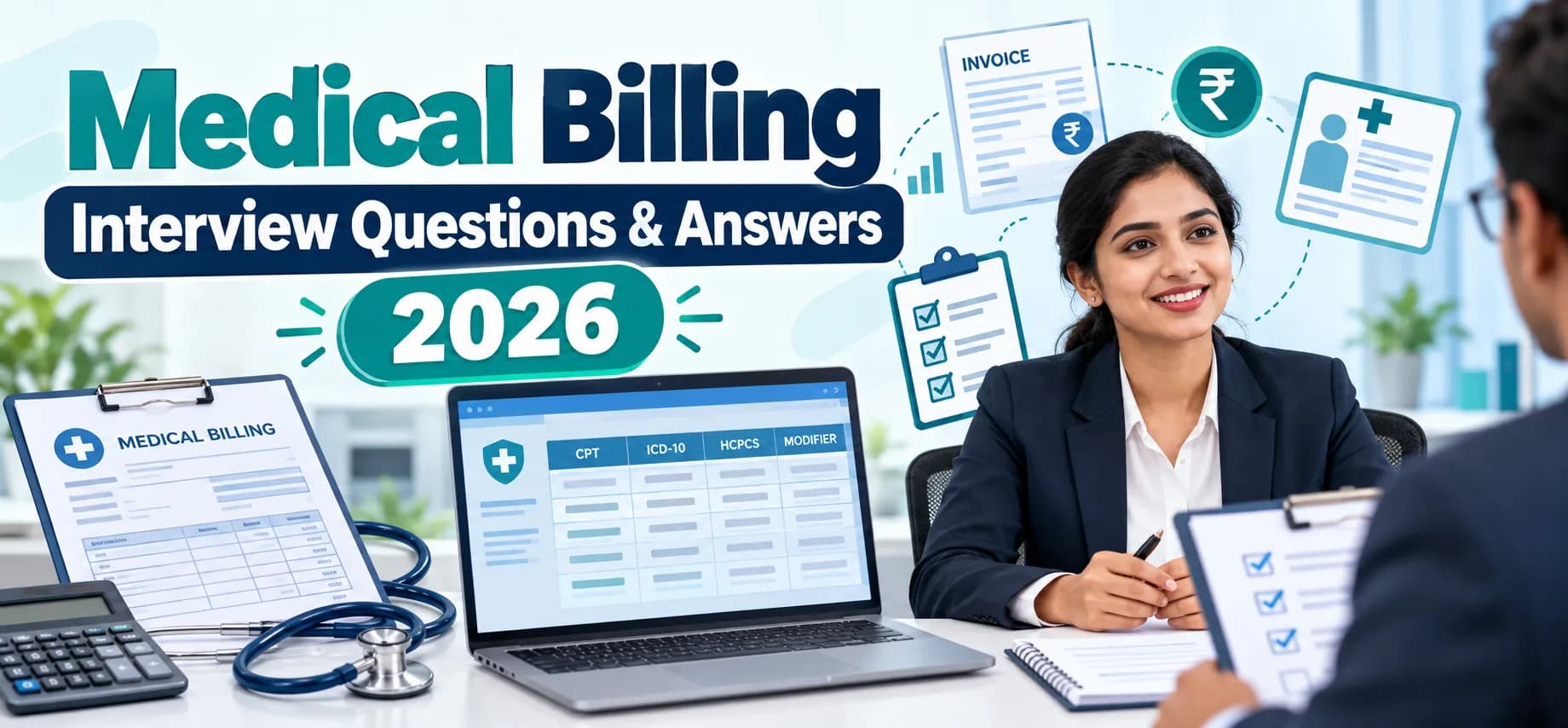
Medical billing professionals keep the healthcare revenue cycle moving, from insurance verification and claim submission to denial management and payment follow-up.
Medical billing professionals play a crucial role in the healthcare revenue cycle. They ensure accurate claim submission, insurance verification, coding coordination, and timely reimbursement for healthcare providers.
If you're preparing for Healthcare Jobs in 2026, particularly medical billing roles, understanding the most commonly asked HR, technical, and scenario-based questions can significantly improve your confidence.
What Does a Medical Billing Executive Do?
A medical billing professional is responsible for:
- Preparing and submitting insurance claims
- Verifying patient insurance eligibility
- Following up on unpaid claims
- Handling claim denials and rejections
- Maintaining billing records
- Coordinating with insurance companies
- Ensuring compliance with healthcare regulations
Top 20 Medical Billing Interview Questions and Answers
1. What is Medical Billing?
Medical billing is the process of creating and submitting claims to insurance companies for healthcare services provided to patients. The goal is to receive reimbursement accurately and on time.
2. Explain the Medical Billing Process?
The medical billing process typically includes:
- Patient registration
- Insurance verification
- Charge entry
- Medical coding
- Claim submission
- Payment posting
- Denial management
- Accounts receivable follow-up
3. What is the Difference Between Medical Billing and Medical Coding?
Medical coding converts diagnoses and procedures into standardized codes like ICD-10, CPT, and HCPCS.
Medical billing uses these codes to prepare insurance claims and obtain payments.
4. What is an ICD-10 Code?
ICD-10 (International Classification of Diseases, 10th Revision) is a standardized coding system used to document patient diagnoses.
Example:
E11.9 – Type 2 Diabetes Mellitus without complications
5. What is a CPT Code?
Current Procedural Terminology (CPT) codes describe medical procedures and services performed by healthcare providers.
These codes are essential for insurance claim submission.
6. What are HCPCS Codes?
Healthcare Common Procedure Coding System (HCPCS) codes are used for services, medical equipment, ambulance services, and supplies not included in CPT codes.
7. What is Insurance Verification?
Insurance verification confirms:
- Active insurance coverage
- Policy validity
- Co-payment
- Deductibles
- Coverage limitations
- Prior authorization requirements
8. What is Prior Authorization?
Prior authorization is approval from the insurance company before certain treatments, medications, or procedures can be performed.
9. What is Claim Denial?
A claim denial means the insurance company refuses payment due to issues such as:
- Incorrect coding
- Missing information
- Eligibility problems
- Duplicate claims
- Lack of authorization
10. What is the Difference Between Claim Rejection and Claim Denial?
Claim Rejection
- Claim is rejected before processing
- Usually due to missing or incorrect information
- Can often be corrected and resubmitted immediately
Claim Denial
- Claim has been processed but payment is refused
- Requires investigation, correction, and appeal if appropriate
11. What is EOB?
Explanation of Benefits (EOB) is a document from the insurance company explaining:
- Services billed
- Amount approved
- Amount paid
- Patient responsibility
- Reasons for non-payment
12. What is Revenue Cycle Management (RCM)?
Revenue Cycle Management is the complete financial process from patient registration to final payment collection.
Medical billing is an important part of RCM.
13. What is Accounts Receivable (AR) Follow-Up?
AR follow-up involves tracking unpaid insurance claims, contacting insurance companies, resolving issues, and ensuring timely reimbursement.
14. What Billing Software Have You Used?
“I have experience with medical billing software and electronic health record systems. I can quickly learn new billing platforms and maintain accurate claim documentation.”
15. How Do You Handle Claim Denials?
Continue Your Journey
Not sure where to go next?
Whether you're searching for your next healthcare opportunity or hiring qualified professionals, Nextenti helps you connect with the right people through AI-powered matching.
👩⚕️ Looking for Jobs?
Browse verified healthcare opportunities across hospitals, clinics and healthcare organizations.
Browse Jobs →🏥 Hiring Talent?
Post jobs and receive AI-matched healthcare professionals faster.
- Review denial reason
- Correct errors
- Gather supporting documents
- Resubmit claims
- Appeal if necessary
- Monitor payment status
16. How Do You Ensure Billing Accuracy?
“I verify patient details, insurance information, coding accuracy, documentation, and claim completeness before submission.”
17. Describe a Challenging Billing Situation.
“A claim was repeatedly denied because of incorrect insurance information. I contacted the patient, verified updated insurance details, corrected the claim, and successfully received reimbursement.”
18. Why Do You Want to Work in Medical Billing?
“I enjoy healthcare administration, problem-solving, and working with data. Medical billing allows me to contribute to efficient healthcare operations while developing a long-term career.”
19. What Are Your Strengths?
- Attention to detail
- Analytical thinking
- Communication
- Organization
- Time management
- Accuracy
20. Why Should We Hire You?
“I have strong attention to detail, understand the medical billing workflow, learn quickly, and can contribute to reducing billing errors while ensuring timely claim processing.”
Medical Billing HR Interview Questions
Employers often ask HR questions to understand your personality and work ethic.
Some common medical billing HR interview questions include:
- Tell me about yourself.
- Why do you want this job?
- Why should we hire you?
- What are your strengths?
- What are your weaknesses?
- Where do you see yourself in five years?
- How do you handle work pressure?
- Are you comfortable meeting deadlines?
- Why are you leaving your current job?
- What motivates you?
Medical Billing Technical Interview Questions
Some frequently asked medical billing technical interview questions include:
- Explain ICD-10.
- What is CPT?
- What is HCPCS?
- What is DRG?
- What is EOB?
- What is ERA?
- Explain Revenue Cycle Management.
- What is insurance eligibility verification?
- What is claim adjudication?
- What is coordination of benefits (COB)?
- How do you resolve claim denials?
- What is medical necessity?
Medical Billing Viva Questions
If you're attending a certification exam or campus interview, you may face viva questions such as:
- What is medical billing?
- What is medical coding?
- What is patient registration?
- What is claim submission?
- What is insurance verification?
- What is prior authorization?
- What is co-payment?
- What is deductible?
- What is coinsurance?
- What is an electronic claim?
Medical Billing Interview Tips
To improve your chances of success:
- Learn the complete medical billing workflow.
- Understand ICD-10, CPT, and HCPCS basics.
- Practice HR and technical interview questions.
- Stay updated on healthcare billing regulations.
- Review common insurance terminology.
- Prepare real-life examples of problem-solving.
- Dress professionally and arrive on time.
- Communicate confidently and clearly.
Common Mistakes to Avoid
- Confusing medical coding with medical billing
- Not understanding insurance terminology
- Giving incomplete answers
- Ignoring claim denial management
- Failing to research the employer
- Not practicing interview questions beforehand
Conclusion
Preparing for medical billing interview questions doesn't have to be overwhelming. Focus on understanding the billing process, insurance concepts, coding basics, and claim management while practicing both HR and technical questions.
Whether you're a fresher or an experienced professional, strong preparation, confidence, and clear communication can help you stand out during interviews. Regularly reviewing common interview questions and staying updated with healthcare billing practices will increase your chances of securing your next medical billing role in 2026.
If you're looking for the latest medical billing jobs, healthcare career opportunities, and resources to grow your career, Nextenti connects healthcare professionals with trusted employers across India.
Frequently Asked Questions
1. What are the most common medical billing interview questions?
Common questions include:
- What is medical billing?
- Explain the medical billing process.
- What is the difference between CPT and ICD-10?
- What is a claim denial?
- How do you handle rejected claims?
- What is Revenue Cycle Management (RCM)?
- What is insurance verification?
- Explain AR follow-up.
2. How can I prepare for a medical billing interview?
Start by understanding the end-to-end medical billing process, revise ICD-10, CPT, and HCPCS codes, practice HR and technical questions, learn common insurance terms, and review real-world billing scenarios.
3. What technical questions are asked in a medical billing interview?
Interviewers often ask about ICD-10, CPT, HCPCS, claim submission, denial management, EOB, ERA, insurance verification, prior authorization, AR follow-up, and Revenue Cycle Management.
4. What HR questions are asked in a medical billing interview?
Typical HR questions include:
- Tell me about yourself.
- Why do you want this role?
- What are your strengths and weaknesses?
- Why should we hire you?
- How do you manage deadlines and pressure?
- Where do you see yourself in five years?
5. What skills are important for a medical billing job?
Key skills include:
- Knowledge of medical billing processes
- Understanding of ICD-10, CPT, and HCPCS codes
- Attention to detail
- Communication skills
- Analytical thinking
- Time management
- Problem-solving
- Familiarity with billing software and Electronic Health Records (EHR)
Most Popular Searches on Nextenti
Featured Jobs
Explore latest openings by profession or location
Jobs by Profession
Browse roles by specialty
Jobs by Location
Explore openings by city
Featured Jobs
Explore latest openings by profession or location
Jobs by Profession
Browse roles by specialty
Jobs by Location
Explore openings by city
Keep Reading
You Might Also Like
 Healthcare Hiring
Why Choose Nextenti? How It Compares with Other Healthcare Hiring Platforms
Compare healthcare hiring platforms and see how Nextenti connects hospitals with professionals through AI matching and flexible hiring.

Meghana Ballekari
29 Oct 2026
 Interview Questions
Pharmacy Interview Questions & Answers 2026 (Freshers + Experienced)
Prepare for pharmacy interview questions with technical, HR and viva questions and answers for freshers and experienced pharmacists.
Sanjay Kagitha
29 Oct 2026
 Resume Tips
Pharmacist Skills for Resume: Key Skills That Get You Hired
Discover essential pharmacist resume skills, technical expertise, and soft skills to stand out to recruiters and find relevant pharmacist jobs.
Srikanth
29 Oct 2026