Phlebotomist Career Guide: Course, Salary, Scope & Jobs in India

Nagaraju Bathini
10 Nov 2026 · 7 min read
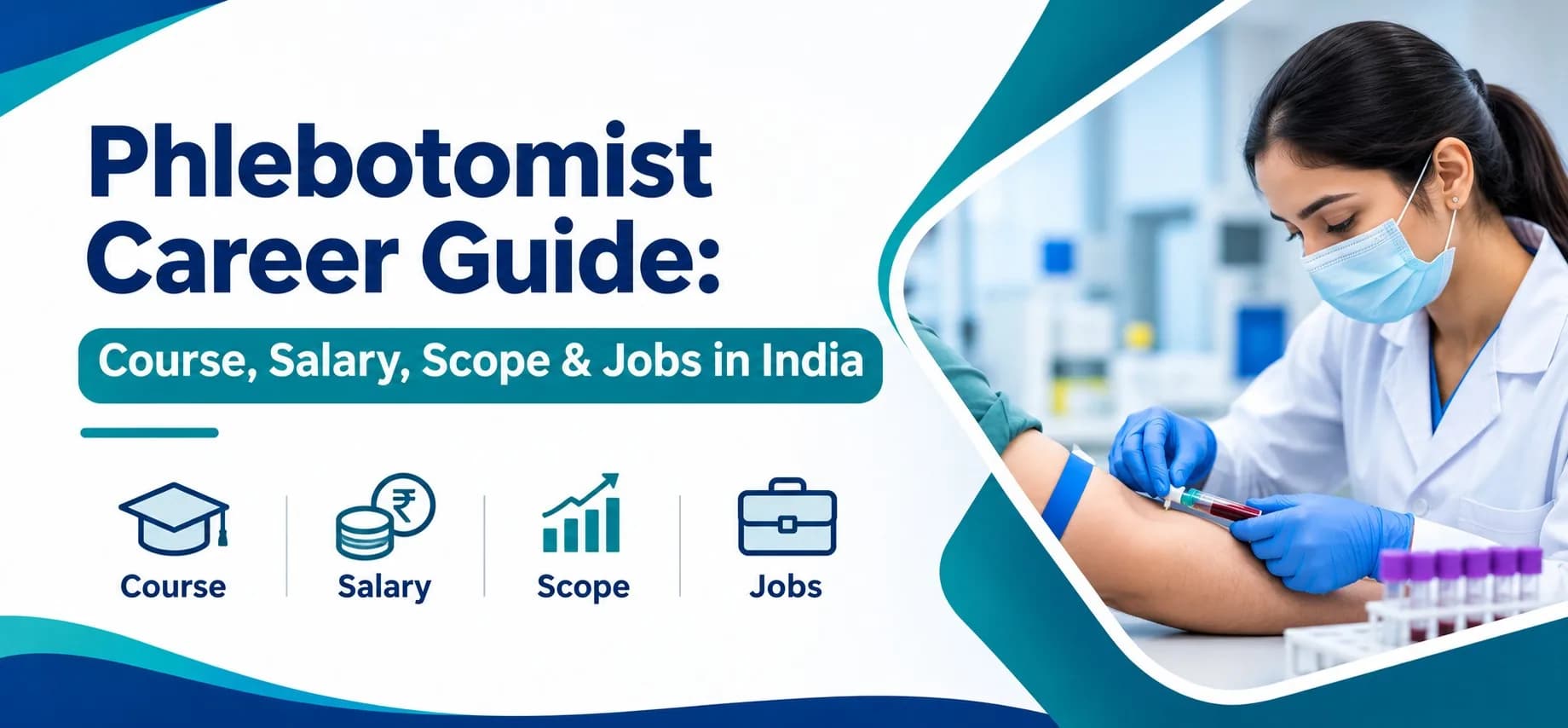
Phlebotomists are trained to collect blood samples, handle specimens correctly, maintain patient records, and follow safety procedures before sending samples for laboratory testing. Accurate blood sample collection is an important part of the diagnostic process in hospitals, diagnostic laboratories, and collection centres, or providing sample collection at patients’ homes, making the phlebotomist an essential part of the diagnostic chain.
A phlebotomist course can provide practical training to students looking for a focused entry into healthcare. This guide covers the phlebotomy course structure, eligibility, duration, fees, salary, career scope, and phlebotomist job opportunities.
What is a phlebotomy course? Structure and syllabus
A phlebotomy course focuses on the practical skills required to safely collect blood and patient specimens and prepare them for laboratory testing. It includes blood collection techniques, specimen handling, infection prevention, documentation, and patient communication.
Compared to BSc Medical Laboratory Technology (MLT), a phlebotomy course focuses on specimen collection and related pre-analytical activities.
Understanding phlebotomy course duration
The phlebotomy course duration depends on the institution, qualification, and training pathway. Therefore, students should check all the details carefully instead of assuming every programme has the same duration.
For example, the Healthcare Sector Skill Council’s current Phlebotomist qualification pack (HSS/Q0501) lists 900 notional hours, including 210 hours of theory, 360 hours of practical training, 60 hours of employability skills, and 270 hours of on-the-job training.
Whereas other institutions may offer shorter certificate-oriented phlebotomy courses. When comparing, look at the practical training, assessment, and certification.
Core syllabus modules
A good phlebotomist course includes classroom learning with practical training.
- Blood Collection Techniques: Venipuncture and capillary blood collection, patient preparation and safe handling of collection equipment.
- Specimen Handling: Correct labelling, documentation, storage, and transportation of samples to help maintain specimen quality.
- Infection Prevention & Safety: Hand hygiene, personal protective equipment, sharps safety and appropriate biomedical waste handling.
- Pre-Analytical Procedures: Understanding factors that can affect specimens before laboratory analysis, including collection, handling and transportation.
- Patient Communication: Explaining the collection procedure, helping patients feel comfortable and responding appropriately to concerns or anxiety.
- Documentation & Collection-Centre Procedures: Maintaining records and following the required protocols for laboratory or collection-centre workflows.
These areas align with the responsibilities outlined in the Healthcare Sector Skill Council's Phlebotomist qualification.
Admissions primer: eligibility and fee structures
Phlebotomist eligibility requirements can vary depending on the qualification, institute, and training pathway, so students should check the specific admission criteria and compare with other phlebotomy courses.
Fulfilling phlebotomist eligibility requirements
According to India’s National Qualification Register, the phlebotomist eligibility is 12th pass with no prior experience.
The Healthcare Sector Skill Council’s Phlebotomist qualification pack (HSS/Q0501) specifies Class 12 with science as the minimum educational qualification and a minimum job-entry age of 18 years. However, other skill-development programmes may differ.
When checking phlebotomist eligibility, candidates should look at:
- Educational qualification: 12th pass is a common requirement, while some recognised pathways provide alternative eligibility routes.
- Science background: Science subjects may be required for specific programmes, particularly those aligned with the HSSC Phlebotomist qualification.
- Age: Minimum age requirements vary by programme; the HSSC qualification specifies 18 years.
- Experience: Most entry-level pathways do not require prior experience, although some alternative routes use relevant work experience as part of eligibility.
Breakdown of phlebotomy course fees
Phlebotomy course fees vary depending on the institute, course format, practical training, and certification.
Continue Your Journey
Not sure where to go next?
Whether you're searching for your next healthcare opportunity or hiring qualified professionals, Nextenti helps you connect with the right people through AI-powered matching.
👩⚕️ Looking for Jobs?
Browse verified healthcare opportunities across hospitals, clinics and healthcare organizations.
Browse Jobs →🏥 Hiring Talent?
Post jobs and receive AI-matched healthcare professionals faster.
When comparing phlebotomy course fees, check whether the total cost includes:
- Practical or laboratory training
- On-the-job or clinical training
- Assessment and certification charges
- Study materials and equipment
- Examination or registration fees
- Internship or placement support
For example, the well-known IGNOU currently lists its six-month Certificate in Phlebotomy Assistance at ₹7,500. Hence, students should carefully compare courses and their syllabus before deciding.
Career scope, job roles and salary potential
While a phlebotomist course can prepare candidates for entry-level roles, the phlebotomy scope is vast, including preparing patients, following collection and safety protocols, correctly labelling specimens, maintaining records, and ensuring samples are handled appropriately before laboratory testing.
Where can phlebotomists work?
After completing a phlebotomy course, candidates can look for opportunities in:
- Diagnostic laboratories and collection centres – collecting and processing patient specimens according to laboratory procedures.
- Hospitals – supporting sample collection for patients across outpatient and inpatient settings.
- Home healthcare services – travelling to patients' homes for scheduled sample collection.
- Corporate and community health programmes – supporting health camps and other organised sample-collection activities.
The exact responsibilities depend on the employer and work setting, so candidates should check the job description before applying.
Phlebotomist salary
Phlebotomist salary depends on factors such as experience, location, employer, type of workplace, and whether the position involves field or home collection.
According to Indeed’s India salary data reports, an average phlebotomist salary is around ₹15,038 per month, although actual salary may vary based on the location and responsibilities.
Finding phlebotomist jobs
After completing the course, candidates can search for phlebotomist jobs through diagnostic laboratories, hospitals, healthcare companies, and home-collection services.
Platforms like Nextenti help discover relevant openings, but job titles may vary so it is worth searching for terms such as phlebotomist, blood collection technician, and sample collection technician.
Nextenti helps you explore relevant phlebotomist jobs while giving you key details such as the required qualifications, location, working hours and role requirements. This makes it easier to compare opportunities and choose roles that align with your skills and career goals.
Conclusion
A phlebotomist course can provide a focused route into the healthcare and diagnostic sector, particularly for candidates who want to enter the workforce without pursuing a longer laboratory-science degree. The right programme should offer relevant practical training, recognised certification and exposure to real-world sample collection procedures.
Career opportunities can be found across diagnostic laboratories, hospitals, collection centres and home healthcare services. As you gain experience, you can also explore further training or related qualifications in medical laboratory technology and other allied-health fields.
If you're ready to take the next step, apply through Nextenti and discover relevant phlebotomist and healthcare opportunities.
Most Popular Searches on Nextenti
Featured Jobs
Explore latest openings by profession or location
Jobs by Profession
Browse roles by specialty
Jobs by Location
Explore openings by city
Featured Jobs
Explore latest openings by profession or location
Jobs by Profession
Browse roles by specialty
Jobs by Location
Explore openings by city
Keep Reading
You Might Also Like
 Healthcare Hiring
Nursing Recruitment in India: How Hospitals Can Find and Hire Qualified Nurses
Explore nurse recruitment in India, including nursing qualifications, hospital staffing requirements, hiring channels, recruitment costs and AI hiring solutions.

Srikanth
12 Nov 2026
 Healthcare Jobs
Nursing Jobs in India: Roles, Eligibility, and Opportunities for Nurses
Explore nursing careers in India, including job opportunities, qualifications, eligibility, salaries, specialisations and overseas nursing jobs.
Meghana Ballekari
12 Nov 2026
 Career Guides
Doctor Jobs in India: How to Find the Right Opportunity
Find doctor jobs in India across hospitals and government institutions. Explore roles, salary ranges, medical specialities and application tips.
Sanjay Kagitha
10 Nov 2026